I have some exciting news: every issue of The Freedman’s Journal is now available online courtesy of Harvard University Library!
You can view it at the link below: https://iiif.lib.harvard.edu/manifests/view/drs:498591889$1i
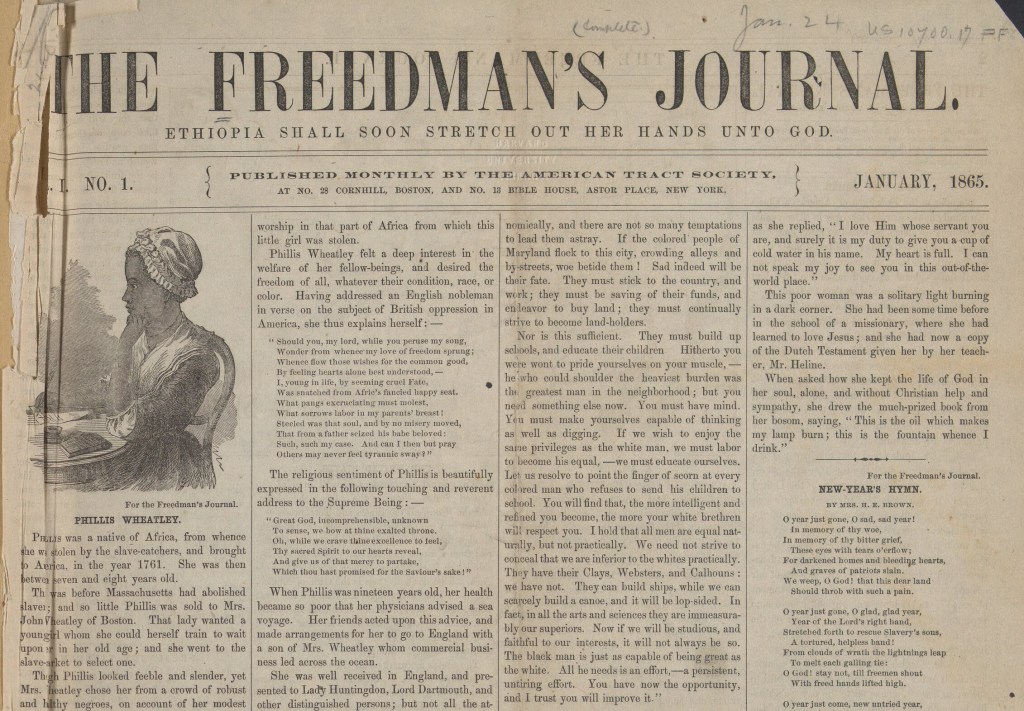
Image Courtesy of Harvard University
The Freedman’s Journal was created by abolitionists to help educate formerly enslaved adults and their families. It was published from January 1865 to December 1866 by the American Tract Society in Boston. Every issue contains a variety of educational content, such as serialized lessons on American history, geography and government. There are also sermons, didactic works of fiction, news articles, and poetry.
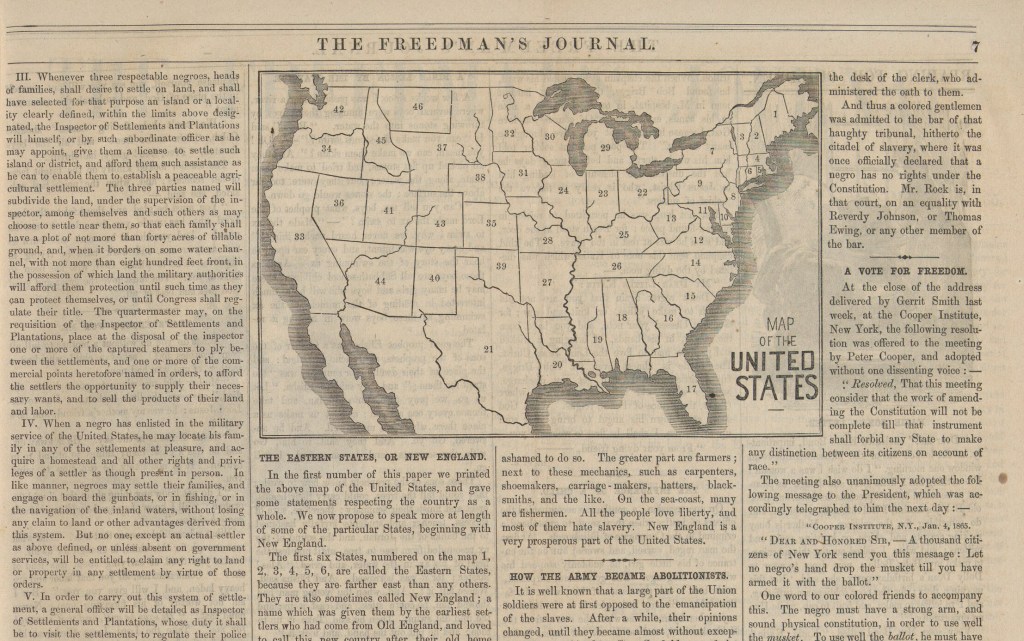
Image Courtesy of Harvard University
While the creators of this paper were well-intentioned, they did not always hit the mark. Some of the content is patronizing, ignorant or outright offensive. Several articles feature nauseating caricatures of loyal slaves and kind masters.

Image Courtesy of Harvard University
The paper had a variety contributors, including established authors, ministers, soldiers, chaplains, teachers, and assorted correspondents. Many contributors also wrote for other periodicals published by the American Tract Society in Boston, e.g. Jane Dunbar Chaplin, Helen E. Brown, Francis Irene Burge Smith, Samuel Burnham Jr., and Jane Stanley Warren.4,5

The Freedman’s Journal and The Freedman Courtesy of Harvard University.
The Christian Banner Courtesy of Perkins School for the Blind Archives.
The Tract Journal and The Child at Home are from my personal collection.
At this time, the Society published five different papers. The Tract Journal was their primary organ. It focused on providing updates on their work, religious news, and articles by ministers. The Child at Home was their children’s periodical and the most successful of the bunch. Every issue included a large custom illustration on the front page and song on the back page. The content included a variety of didactic literature, Bible lessons, and poetry.

During the Civil War, the Society created three additional publications, each with a specialized audience. The Christian Banner was created in 1861 for soldiers and sailors. It focused on encouraging and ministering to them. The paper mainly included didactic literature, calls to conversion, patriotic messaging and news. The front page of the paper always featured a large color image of the American Flag. An image of the August 1862 edition is below Courtesy of Perkins School for the Blind Archives. This edition included sheet music for “Battle Hymn of the Republic” on the back page. You can view all the pages, including typed transcriptions, at this link: https://www.flickr.com/photos/perkinsarchive/6629789125/in/photostream/

Image Courtesy of Perkins School for the Blind Archives
The Freedman was created in 1864 for formerly enslaved children and was heavily focused on educational content and didactic children’s literature. The Society quickly discovered the need for more mature content, so they created The Freedman’s Journal in 1865. It was intended for formerly enslaved adults and their families.

Images Courtesy of Harvard.
A lot of content in The Freedman and The Freedman’s Journal was written by one of my research subjects, Mrs. Helen E. Brown. One of her previously published books, John Freeman and his Family, was partially reprinted in serialized form in 1865. She also wrote another serialized novel, “Our Home”, specifically for the Freedman’s Journal.

Image Courtesy of Harvard University
The Freedman’s Journal ceased publication in December 1866 when the American Tract Society decided to merge it with The Freedman. The latter continued publication until the end of 1869, when the Society underwent a major reorganization. “Our Home” was still being published when the paper ended, so the story was completed within the The Freedman. Brown wrote two additional serialized novels for that paper: “Everything in its Time” and “After Tea.”9
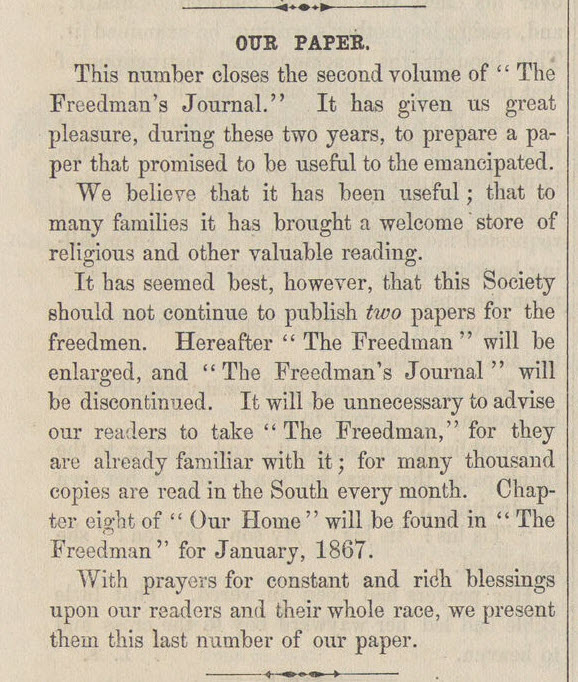
Image Courtesy of Harvard University
One final thought – it’s quite interesting to compare The Freedman’s Journal with black newspapers like The Christian Recorder, The Elevator, The New Orleans Tribune, The Educator, The Anglo-African, etc. They often expressed very different ideas about what the United States should become, and the place of Black Americans within it. If I can ever find the time, I would love to write a book about it.
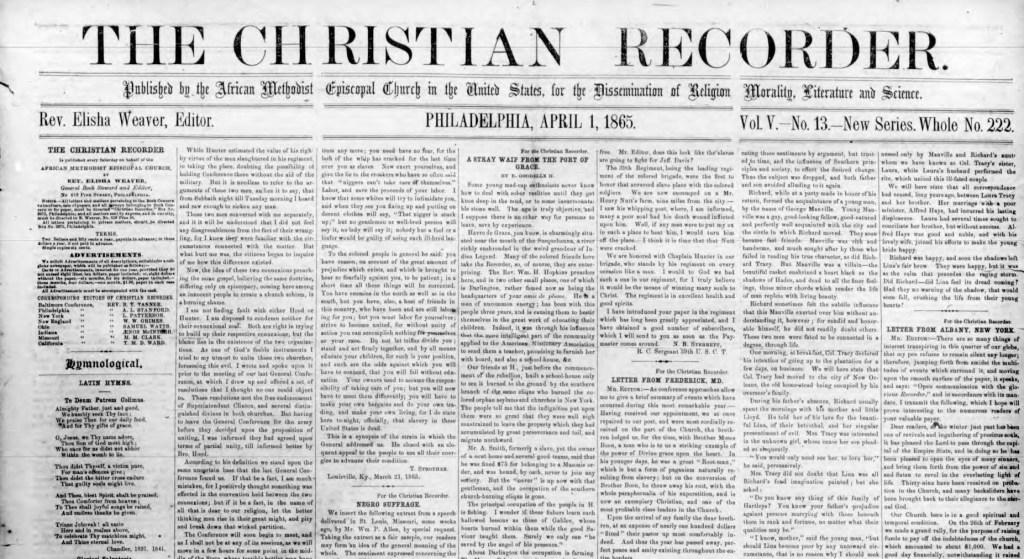
Image Courtesy of Payne Theological Seminary
Endnotes:
1 – The Freedman’s Journal, January 1865, page 1.
2 – The Freedman’s Journal, February 1865, page 7.
3 – The Freedman’s Journal, May 1865, page 17.
4 – Francis Irene Burge Smith often used the alias Fanfan.
5 – Samuel Burnham Jr. used the aliases Uncle Paul and Victor.
6 – The Tract Journal, May 1865
https://archive.org/details/tract-journal-186505
The Freedman’s Journal, February 1865
You can view it at the link below: https://iiif.lib.harvard.edu/manifests/view/drs:498591889$1i
The Christian Banner for the Soldier and Sailor, August 1862
https://www.flickr.com/photos/perkinsarchive/6629789125/in/photostream/
The Child at Home, April 1866
https://babel.hathitrust.org/cgi/pt?id=hvd.32044051072031
The Freedman, May 1864
https://babel.hathitrust.org/cgi/pt?id=uva.x000177178
7 – Fifty-Second Annual Report of the American Tract Society, Presented at Boston, May 30, 1866, page15.
8 – The Freedman’s Journal, March 1865, page 9.
9 – “Everything in its Time” was published from April 1868 to November 1868. “After Tea” likely began publication in January 1869. I have not located a complete copy, but I am working on it.
10 – The Freedman’s Journal, December 1866, page 46.
11 – The Christian Recorder, April 1, 1865.
 Lost History Books