After several months of searching, I have finally identified this school as the Colored Orphan Asylum in New York City! This may seem boring to you, but I am over the moon.

Let us begin at the beginning.1 I stumbled across this fascinating image of black children completely by chance. Last year, I purchased a bound volume containing a full years’ worth of two periodicals: The Child at Home and The Well-Spring. I was primarily interested in the former, but I enjoyed browsing through both. I came across this image in the January 22, 1869 edition of The Well-Spring.

This item is in my personal collection.
A few things immediately piqued my interest. During this time period, images of black children with a black teacher were exceptionally rare. I’ve only seen a few and I doubt many more exist. The composition is very unusual too. The perspective of the photo is odd for an artist’s interpretation of a school. The desk in the lower right hand corner is in the foreground, despite offering nothing compelling to look at. The teacher is sitting at an odd angle relative to the students. Also the window dressing is so plain – artists often preferred to concoct elaborate curtains or none at all.
My gut immediately suspected this was based on a real photograph. A photographer forced to make concessions to space and light would compose an image like this; an artist making something up would not. So I began to closely examine the image and accompanying article, looking for some clue.

The clothing is very odd. I initially though they might be baptismal robes, but that didn’t provide any insight. Also the risers are unusual; most school buildings were very simple and often used improvised materials.
The article accompanying the image refers to schools founded by the American Missionary Association (AMA) for formerly enslaved children. It even includes a short composition by a young girl in Virginia. I spent countless hours looking through the digitized archives of the AMA without making any progress. The only image of a school that I found was of the Sea-Island School No. 1 on St. Helena Island in South Carolina.

Image Courtesy of the New York Public Library
These images were all made by hand by skilled artists and engravers. So it seemed unlikely that the AMA would create the mystery image and not use it in their other materials. Thus this line of inquiry didn’t produce any useful leads. I also spent a lot of time looking at schools for freed children in Virginia. This also proved to be a fruitless endeavor.
My big break was made completely by accident. Some unrelated research into author Helen E. Brown led me to learn more about American Female Guardian Society (AFGS). Brown edited their periodical, The Advocate and Family Guardian, for over twenty years. I stumbled upon an article in that paper that mentioned that stereoscopic photos were taken of their buildings.
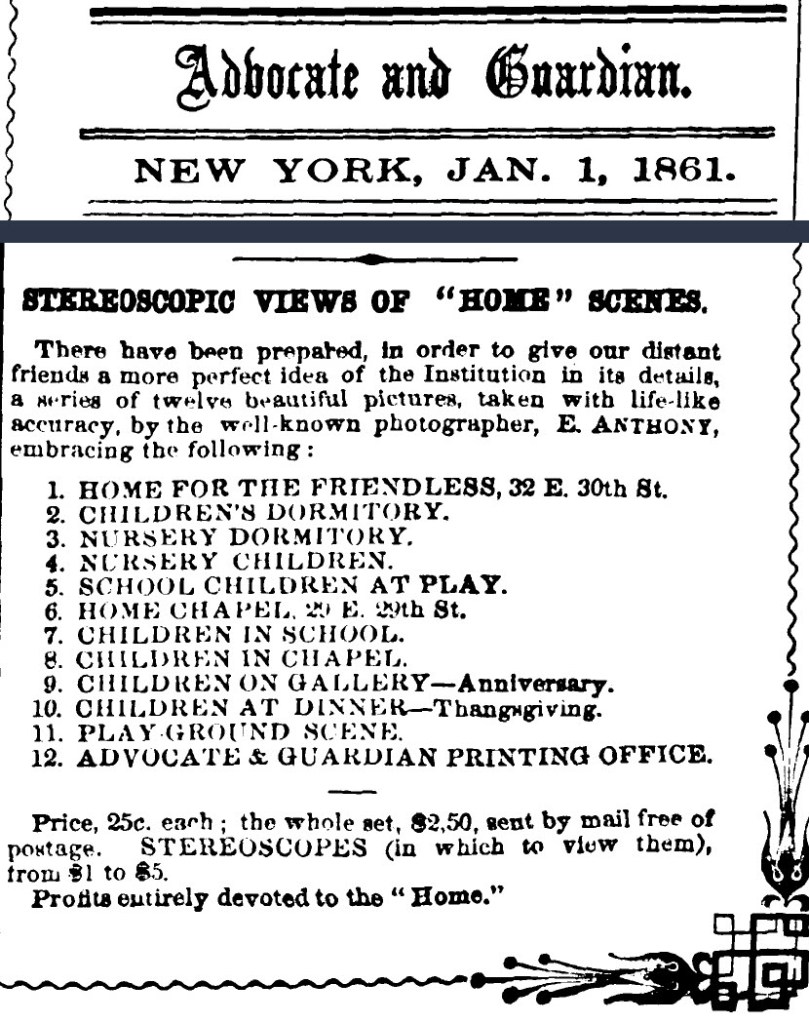
Image number twelve was particularly tantalizing, since it was a picture of their printing office. I set out to find these photos, and was fortunate enough to discover a complete set in the private collection of Jeffrey Kraus.5
I eagerly scrolled through the photos to find the printing office, but image number nine took my breath away. There were children sitting on risers similar to that in my mystery image – that seemed like a hot new lead. I never considered that the image might depict an orphanage. That would explain why the kids wore the same garments too. This page contained photographs of multiple orphanages so I scrolled through them to get a better idea of what orphanages looked like in this time period. I didn’t have to scroll very far to find the mystery photo.

The Jeffrey Kraus Collection5
I couldn’t believe it. Here was an exact match, and I wasn’t even looking for it! Jeffrey Kraus kindly permitted me to include the image above, but you should view his other photographs; they are fascinating!
You can see the images of orphanages in New York City here: https://antiquephotographicscollections.com/category/new-york-city/keyword/colored-orphan-asylum/
He also has a blog post dedicates to the history of the Colored Orphan Asylum. The facility was burned down during the New York Draft Riots of 1863 and his article provides a good overview of the tragic event. Fortunately, no children were killed, but over one hundred black residents of New York City were lynched. https://antiquephotographics.com/the-colored-orphan-asylum-nyc/
So, the initial mystery has been solved, however the answer prompts even more questions. The first one to come to mind is when exactly was the photo taken? I can’t answer that precisely, but I found an ad for the stereoscopic views in Friends’ Review on February 16th, 1861. The accompanying article includes an summary of their annual report. I suspect that the full report might have more information about when and why these photos were taken, but I have been unable to get copies thus far.
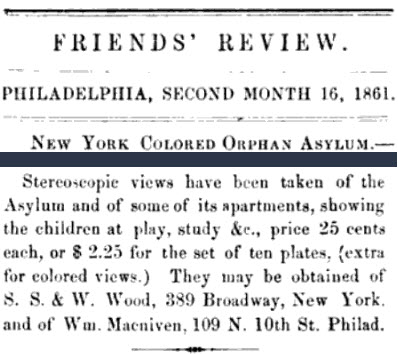
This leads to another question – what other photos were taken of the orphanage. Jeffrey Kraus has four photos from this set, but the ad mentions ten. Also, when and where was this engraved image originally made? Since the photo is from at least 1861, I doubt it was made for this paper in 1869. I’ve looked at hundreds of nineteenth century engravings in children’s periodicals and the style of this engraving is noticeably different from other images in The Well-Spring. I suspect the wood block used was created years before 1869. But if that is the case, why would a newspaper published in Boston have an old wood block of an institution in New York City?
So far, I haven’t had much luck answering those questions, though I did find a similar engraving in an English periodical titled The Children’s Friend.
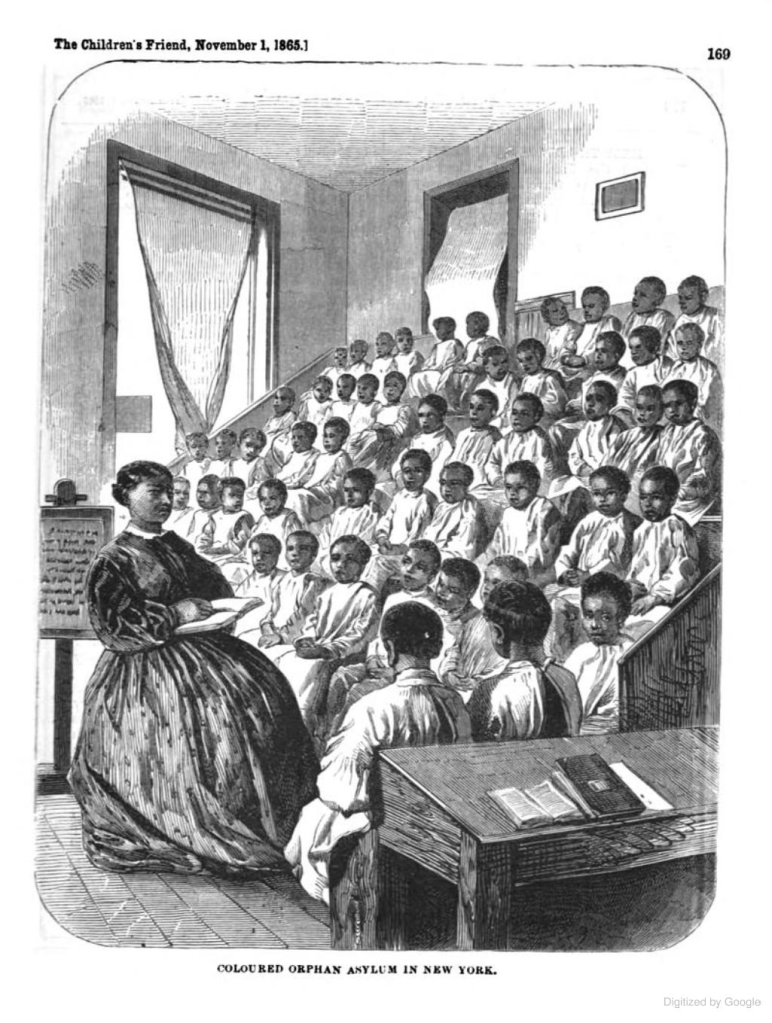
This image is slightly different, so it was definitely not printed from the same wood block. If you look closely at the stereoscopic photograph, you will notice that the right and left sides are slightly different. The leg of the poster stand behind the teacher is in full view on the right, but mostly obscured on the left. The engraving above appears to based on the right side, whereas the engraving from The Well-Spring appears to be based on the left side. I’m not sure if anything useful can be derived from that information, but it is interesting. With a little luck, hopefully I will be able to find out more soon.
If you have any leads for me, please reach out!
Notes
1 – Most of the content of this article was originally published on my social media pages in December 2023 and January 2024.
2 – The front cover of The Well-Spring, January 22, 1869.
3 – Schomburg Center for Research in Black Culture, Photographs and Prints Division, The New York Public Library. “Sea-Island School, No. 1 – St. Helena Island” The New York Public Library Digital Collections. 1862 – 1869. https://digitalcollections.nypl.org/items/fe3acd60-d6cc-0130-dcab-58d385a7bbd0
4 – Advocate and Guardian, January 1, 1861, page 14. https://www.google.com/books/edition/Advocate_and_Family_Guardian/8XQXAAAAYAAJ
5 – You can see the images of orphanages in New York City here: https://antiquephotographicscollections.com/category/new-york-city/keyword/colored-orphan-asylum/
6 – Friends’ Review, February 16, 1861, page 376. https://www.google.com/books/edition/Friends_Review/visrAAAAYAAJ
7 – The Children’s Friend, November 1, 1865, page 169. https://www.google.com/books/edition/The_Children_s_Friend/YR0FAAAAQAAJ
 Lost History Books