I realize that Christian children’s periodicals from the 19th century is not the most riveting topic of all time. But I have accidentally fallen down a deep and fascinating rabbit hole.
Frequent readers will know that I’ve been very interested in materials published by the American Tract Society in Boston for quite a while. A few weeks ago, I resumed searching for editions of The Child at Home (CAH) from 1870. I was hoping to glean some information about whether their subscription list was combined with The Freedman (TF) once the latter folded.1
My usual process for searching for rare materials involves doing a quick google search and then slowly refining the results. On this occasion, I searched for “The Child at Home” 1870.
This yielded a few interesting results from Getty Images.

Getty has a lot of public domain images on their site, but the original source is rarely identified. Fortunately, you can usually figure it out with a reverse image search. So I selected a photo and used Google Lens to look for matches.
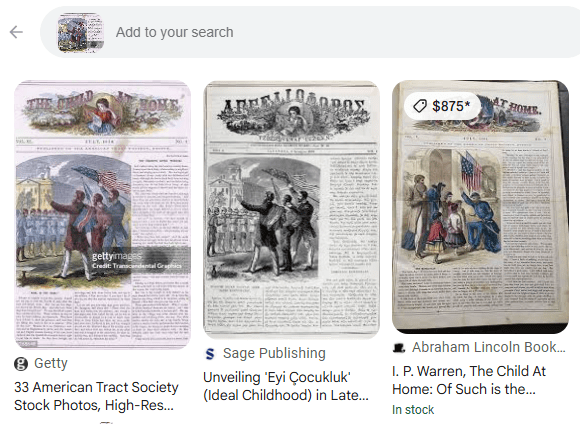
The illustration in the middle nearly took my breath away. I recognized the masthead, but the title is written in Greek! Clicking on the result took me to an article titled “Unveiling ‘Eyi Çocukluk’ (Ideal Childhood) in Late Ottoman Turkish Children’s Literature: A Discourse Analysis of Angeliaforos Çocuklar İçün (The Messenger for Children).” It was written by Prof. Hayrullah Kahya and published in SAGE Open.2
The children’s magazine is titled: Αγγελιαφόρος Τζοτζουκλάρ ιτσούν (Angeliaforos Çocuklar İçün). It actually isn’t in the Greek language, but rather Karamanli Turkish, which happens to use the Greek Alphabet. Prof. Kahya’s article also directed me to an identical Armenian publication titled Աւետաբեր Տղայոց Համար (Avedaper Deghayots Hamar) and a similar Bulgarian publication titled Зорница (Zornitsa). All three papers were published in the Ottoman Empire by the American Board of Commissioners for Foreign Missions.
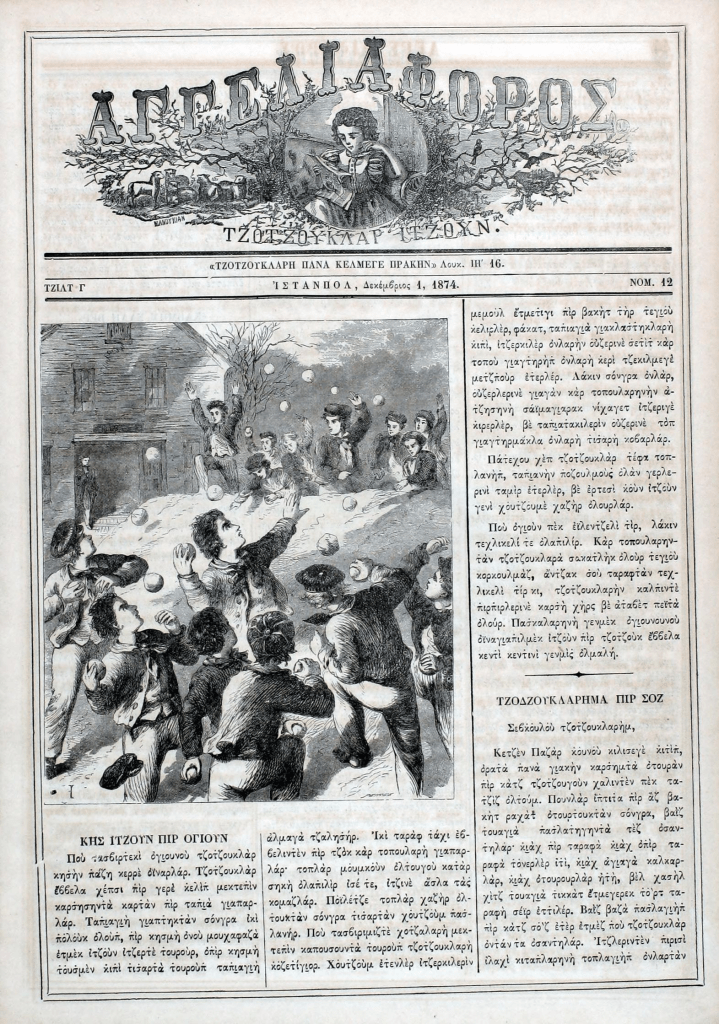
Fortunately, many issues of Angeliaforos Çocuklar İçün (ACI) and Avedaper Deghayots Hamar (ADH) have been digitized.3 I recently finished reviewing the cover images of the first four years and discovered that nearly all the images are from The Child at Home. I suspect a lot of the content has been borrowed as well, but I haven’t done that analysis yet.
Working on a rush of pure adrenaline, I systematically indexed all the cover images from CAH from 1859-1872.4 Then I compared it with the The Freedman, ACI, and ADH.5 So far I’ve located 8 images that are shared by all four publications. I’m still searching for some 1870 issues of The Child at Home, so there may be even more.

The Freedman
Աւետաբեր Տղայոց Համար (Awetaber Tghayoc Hamar)
Αγγελιαφόρος Τζοτζουκλάρ ιτσούν (Angeliaforos Çocuklar İçün)
On a whim, I decided to dig a little deeper into ACI and found a particularly unique gem. The December 1874 edition contains a musical score titled: ΚΑΒΜΗΜ ΣΑΛΗ ΒΕΡ (KAVMIM SALI VER).6
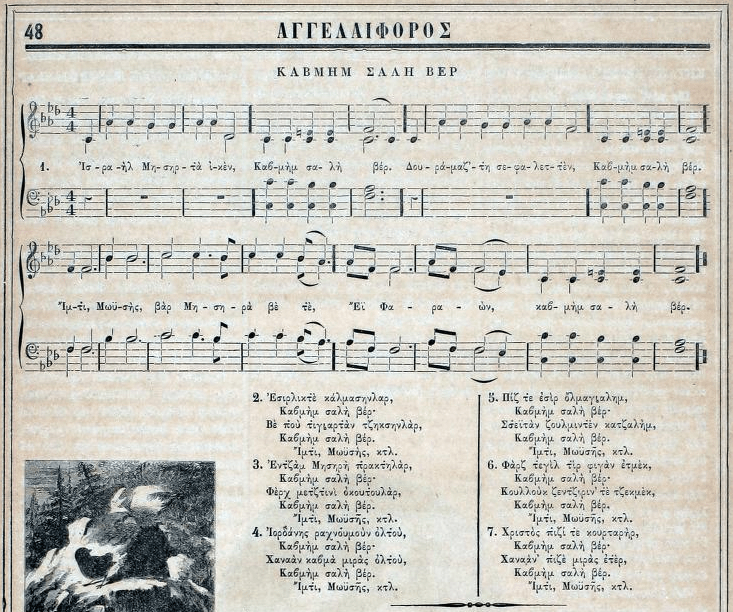
I had the score transcribed into MuseScore so I could listen to it.
The melody was very familiar, but I couldn’t quite place it. After a bit of searching, I learned that a wonderful Turkish researcher had translated these lyrics from Karamanli Turkish into standard Turkish.7 I pasted them into Google Translate and instantly recognized it!
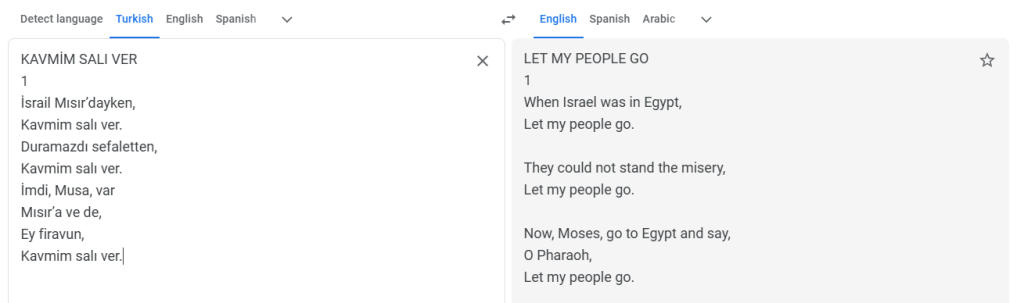
This is the popular African-American Spiritual titled: “Go Down, Moses.” The song predates the war, but the lyrics were first published in 1861 along with an original tune.8 Some years later, the song was popularized by the Fisk Jubilee Singers. They performed it and many others on a world tour; they even sang for Queen Victoria. The musical score in their book exactly matches the one in ACI.9
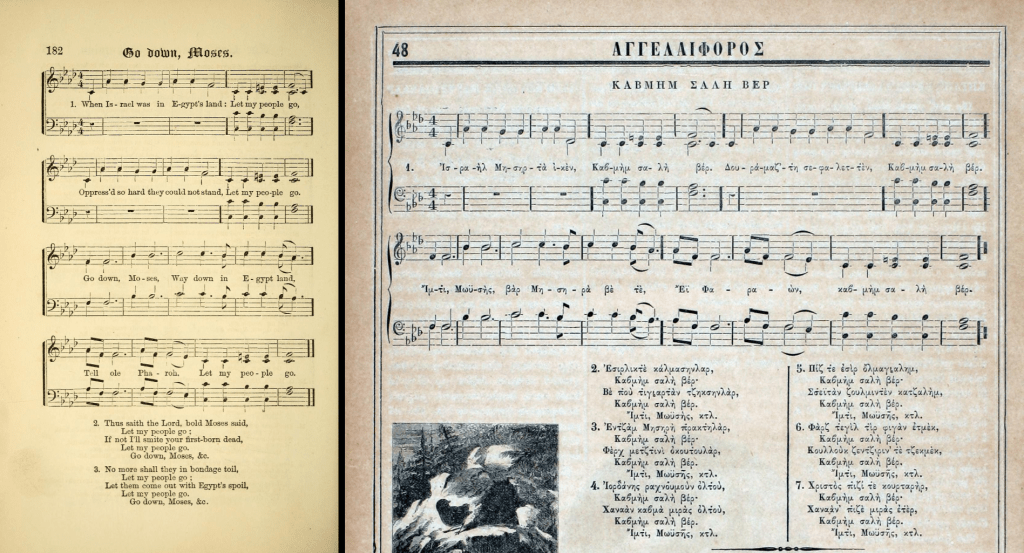
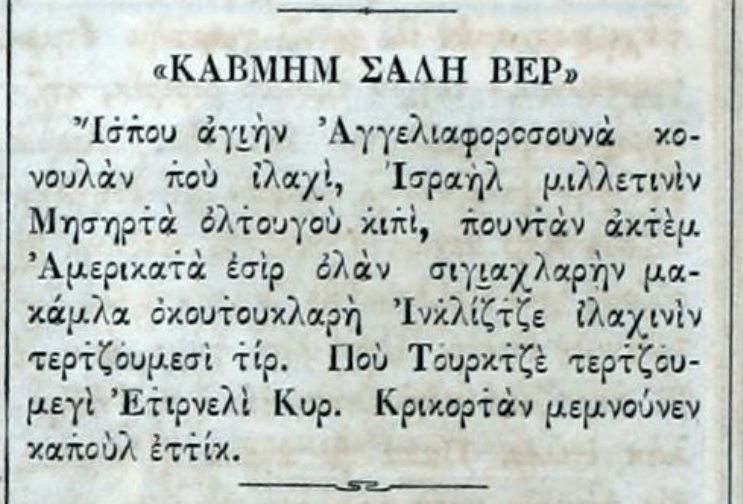
I’m not sure how it made its way to the Ottoman Empire. The associated article thanks Mr. Κριχορ (Krikor) of Edirne for providing the translation.10 But I have no idea where he got it from.
I really wanted to hear how this song would sound in Turkish. So I hired a Turkish singer to perform a couple verses in English and Turkish. Please enjoy the talented Najwa Otky singing “Go Down, Moses” / “KAVMİM SALI VER.”
As an added bonus, I asked her to improvise a new tune and sing all of the lyrics in Turkish. The result is one of the most beautiful songs I have ever heard. I hope you enjoy this as well.
My research into these periodicals is ongoing. Stay tuned for more updates!
Appendix A
| Original Title | Latinized Title | English Translation |
| Αγγελιαφόρος Τζοτζουκλάρ ιτσούν | Angeliaforos Çocuklar İçün | The Messenger for Children |
| Աւետաբեր Տղայոց Համար | Awetaber Tghayoc Hamar | The Messenger for Children |
| Зорница | Zornitsa | Daystar |
Appendix B
| CAH | TF | ACI | ADH |
| 1865-04 | 1866-05 | 1874-04 | 1874-04 |
| 1865-09 | 1869-02 | 1873-03 | 1873-03 |
| 1865-10 | 1866-12 | 1873-09 | 1873-09 |
| 1866-11 | 1867-05 | 1873-06 | 1873-06 |
| 1867-03 | 1868-12 | 1874-08 | 1874-08 |
| 1867-07 | 1867-12 | 1874-09 | 1874-09 |
| 1867-08 | 1868-05 | 1874-11 | 1874-11 |
| 1867-09 | 1868-11 | 1874-06 | 1874-06 |
Footnotes
- For more information about The Freedman, please see Literature for the Freed People. ↩︎
- Hayrullah, Kahya. “Unveiling ‘Eyi Çocukluk’ (Ideal Childhood) in Late Ottoman Turkish Children’s Literature: A Discourse Analysis of Angeliaforos Çocuklar İçün (The Messenger for Children).” Sage Open 14, no. 4 (October 30, 2024). https://journals.sagepub.com/doi/full/10.1177/21582440241281357.
↩︎ - Many issues of Αγγελιαφόρος Τζοτζουκλάρ ιτσούν (Angeliaforos Çocuklar İçün) can be found on the Internet Archive: https://archive.org/search?query=ANGELIAPHOROS&sort=title
Աւետաբեր Տղայոց Համար (Awetaber Tghayoc Hamar) is available via the Pan-Armenian Digital Library: https://arar.sci.am/dlibra/publication/297977#structure
It is also available via the Union Catalogue of Armenian Continuing Resources: https://tert.nla.am/mamul/Avetaber_tghayoc_hamar_c.p/Table.html
↩︎ - Contact me if you would like a copy of the index I’ve created. ↩︎
- See appendix B for a table of corresponding editions. ↩︎
- Αγγελιαφόρος Τζοτζουκλάρ ιτσούν (Angeliaforos Çocuklar İçün). “KAVMİM SALI VER.” December 1874. https://archive.org/details/Angeliaphoros1874/page/n48/ ↩︎
- Çetin, Yasin. “KAVMİM SALI VER (KARAMANLICA İLAHİ).” Metaboles (blog), December 29, 2019. https://metaboles.blogspot.com/2019/12/kavmim-sali-ver-karamanlica-ilahi.html?m=1. ↩︎
- Baker, Thomas. The Song of the “Contrabands” “O Let My People Go.” New York: Horace Waters, 1861. https://digital.librarycompany.org/islandora/object/Islandora%3A9540#page/1/mode/1up. ↩︎
- Pike, Gustavus D. The Jubilee Singers, and Their Campaign for Twenty Thousand Dollars. Hodder and Stoughton, 1873. https://archive.org/details/jubileesingersth00pike. ↩︎
- Αγγελιαφόρος Τζοτζουκλάρ ιτσούν (Angeliaforos Çocuklar İçün). “KAVMİM SALI VER.” December 1874. https://archive.org/details/Angeliaphoros1874/page/n2/mode/1up ↩︎
 Lost History Books