This page contains a full list of materials that I’m searching for as of December 27, 2025. If you have any leads, please reach out! There are five sections: books, manuscripts, periodicals, photographs, and artwork.
Books
Light and Dark Side by William Forster Mitchell
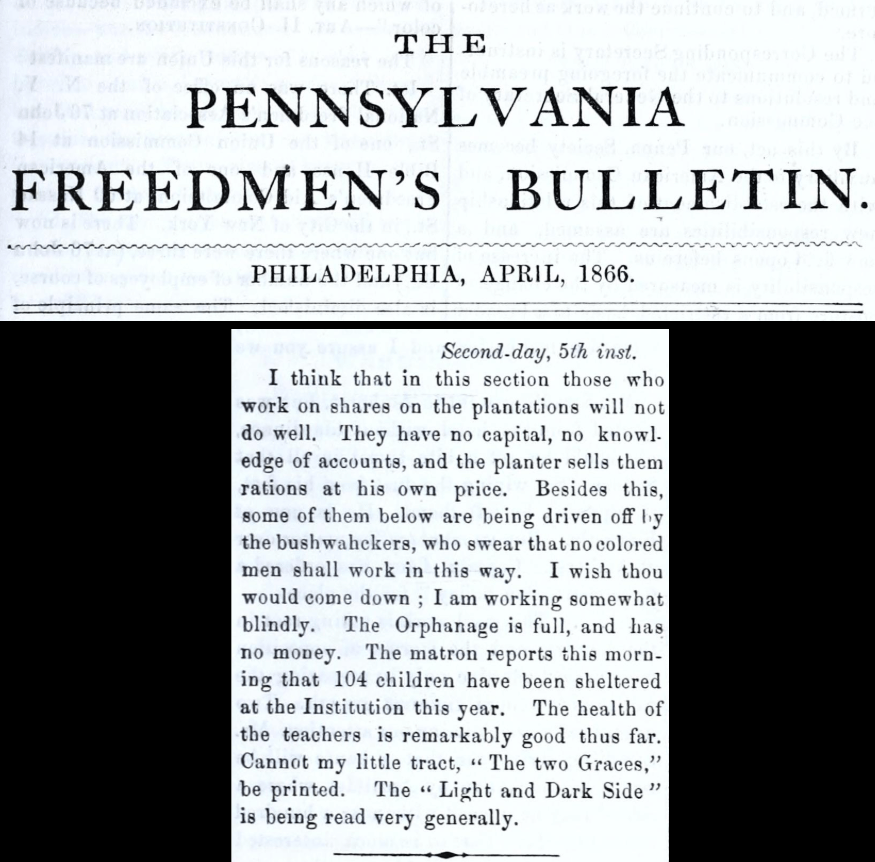
The April 1866 edition of the Pennsylvania Freedmen’s Bulletin indicates that Mitchell wrote a small tract titled Light and Dark Side and it was “being read very generally.” I’m not sure who published it or when. His letter also requests that another tract be published which was titled: The Two Graces. It’s unclear if that ever happened. Mitchell belonged to the Religious Society of Friends, commonly known as Quakers. I’ve thoroughly searched the reports of the Tract Association of Friends to no avail. I’ve also searched the American Friends’ Letters collection at Haverford. I currently only have one vague lead. The corresponding secretary of the Pennsylvania Freedmen’s Relief Association was James E. Rhoads, M. D. He is most notable for being the president of Bryn Mawr College from 1884-1894. More of his correspondence is at Haverford and other institutions and remains to be searched.
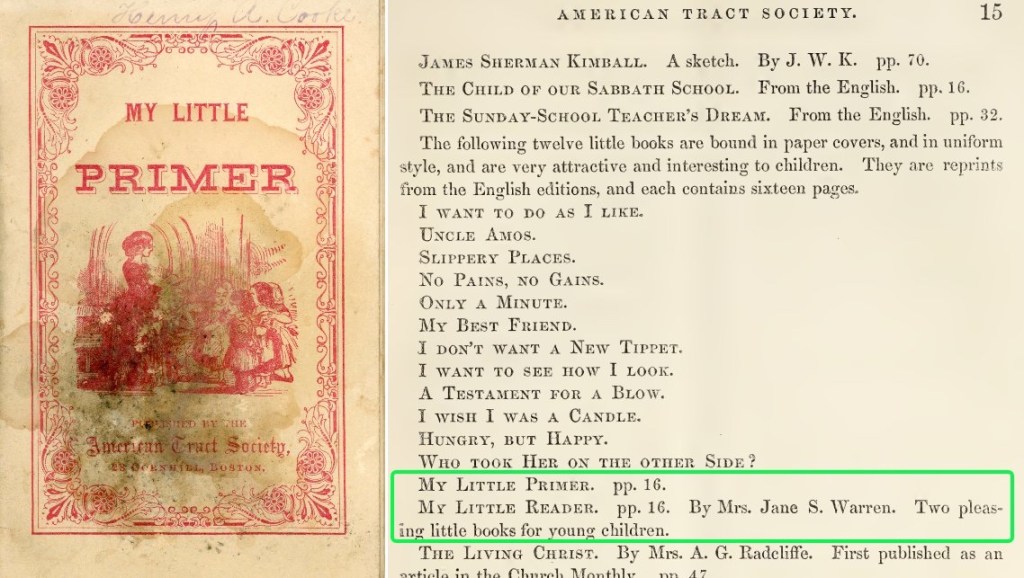
My Little Reader by Jane Warren
My Little Reader by Jane Warren for the American Tract Society in Boston around 1865. I have already found a copy of the companion volume, My Little Primer.
Words of Cheer for the Christian Soldier by Helen E. Brown
This is a small book with 64 pages that was created specifically for soldiers. It published by the American American Tract Society in Boston around 1861.
Words of Counsel for the Wise Soldier by Helen E. Brown
This is a small book with 64 pages that was created specifically for soldiers. It published by the American American Tract Society in Boston around 1861. I found an eBay sale record from 2017 so a copy likely still exists. The images from that listing indicate that the book contain warnings against a variety of vices including: gambling, drinking, smoking, cursing, and “impurity.” I currently have no leads.
Words of Healing for the Sick Soldier by Helen E. Brown – Found!
This is a small book with 32 pages that was created specifically for soldiers. It published by the American American Tract Society in Boston around 1861.
This book has been found at the Frontier Army Museum in Fort Leavenworth, Kansas. They generously provided the image below.

My Little Picture Book by Jane S. Warren
A Trip to the Country by Jane S. Warren
My Ride in Winter by Jane S. Warren
Little Pictures for Little People by Jane S. Warren
Child’s Lesson Book by Jane S. Warren
The Flag of Our Country by Israel Perkins Warren
This tract was created specifically for service men. I suspect it was reprinted in the Freedmen’s series, but I’ll need to view it to confirm.
Posters accompanying The Bible Reader
In early 1862, the American Sunday School Union published The Bible Reader. It was accompanied by a set of posters which are depicted in the broadside below. There are no known copies and I have no leads.

Teaching the Contrabands
Chicago History Museum, ICHi-036123
Posters accompanying First Lessons
In early 1862, the American Tract Society in New York published a small pamphlet titled: First Lessons. It was accompanied by a set of posters, but no copies are known to exist. I currently only have one lead. A large archival collection of American Tract Society records is housed at the Texas Baptist Archive in Waco, TX. It’s an unprocessed collection of several hundred boxes. It’s theoretically possible that a copy could be there – but finding it would be quite an endeavor.
Freedman’s Lessons
The American Tract Society in Boston published Freedman’s Lessons around 1865 though no copies are known to exist. They are described as a set of 16 cards printed on a single sheet that could be cut and distributed to students.
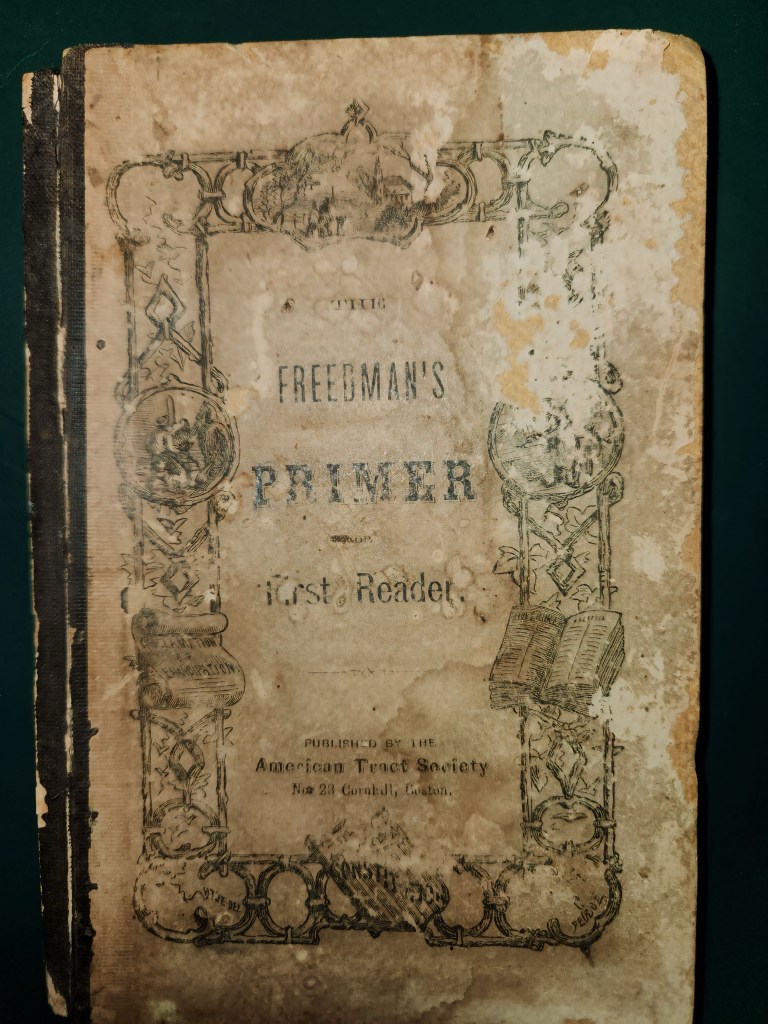
The Freedman’s Primer – FOUND!
The Freedman’s Primer by the American Tract Society in Boston in 1864. Fisk University used to have a copy was last seen in the 1970s. I’ve tracked down a card catalog record from that time period, so it definitely used to be there. But there is no trace of it now.
This item has been found! The only known copy is currently in the hands of a private collector. He was able to confirm that it is identical to a later edition of the book titled The Lincoln Primer.
First Sunday School Reader – FOUND!
First Sunday School Reader by the American Baptist Publication Society published in 1865. It appears this was published the same year as the First Reader for Freedmen. I suspect they are practically the same book, but I want to see what they changed.
This item has been found! I found a copy for sale and have made a digital copy available online for free.

Manuscripts
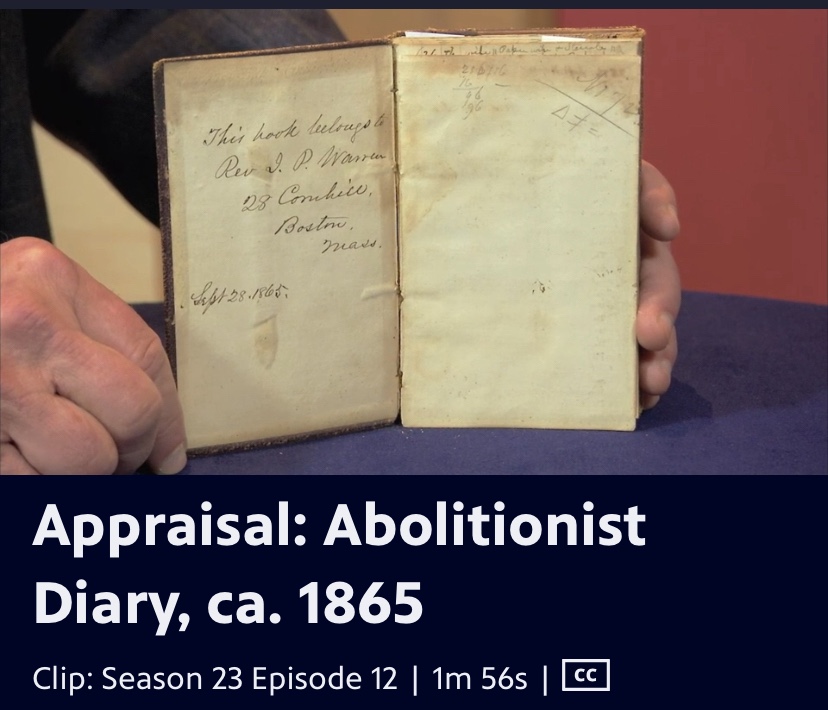
Diary of Reverend Israel Perkins Warren
The Diary of Reverend Israel Perkins Warren, secretary of the American Tract Society in Boston from 1865. The diary surfaced on an episode of Antiques Roadshow that aired in 2019, but I have no idea what happened to it.
Letters of William F. Mitchell to the Pennsylvania Freedmen’s Relief Association.
From 1864-1867, William Forster Mitchell superintended several schools for Black children in Tennessee and Alabama. He was supported by the Pennsylvania Freedmen’s Relief Association and regularly corresponded with them. A lot of his correspondence was published in The Pennsylvania Freedmen’s Bulletin, but I’ve been unable to locate the originals. I’m particularly interested in a letter dated 1866-03-05 which was published in the April 1866 edition of the Bulletin.
Letters of Anne Maria Mitchell Payne
A selection of the letters of Anne Maria Mitchell were transcribed by her daughter, Alice Payne Amey, and published in Historic Nantucket in the 1960s. The articles were accompanied by photos from Bill Hadon and Universal Photo Shop. I have contacted the descendants of Alice P. Amey, the Nantucket Historical Society, and the Nantucket Athenaeum to no avail. The letters are likely still in private ownership but I cannot locate them.
Letters relating to Slave Songs of the United States
The first book of black music was published in 1867. This landmark collection of 136 songs was simply titled: Slave Songs of the United States. The acknowledgements of the book lists several contributors with no located correspondence. I’m particularly interested in letters from Anne Maria Mitchell and George H. Allan. I’m also interested in whoever contributed the seven songs from Louisiana. The contributor is not named, she is simply described as “a lady who heard them sung, before the war, on the ‘Good Hope’ plantation, St Charles Parish, Louisiana.” At that time, the estate was owned by Thomas Oxnard, Edouard Oxnard and Brice Similien LaBranch. It is quite remote, being over 25 miles up river from New Orleans.
This book was compiled by three individuals: William Francis Allen, Charles Pickard Ware and Lucy McKim Garrison. All three of them were involved in compiling these songs and their archival resources are scattered across multiple institutions.
William Francis Allen’s collection is at University of Wisconsin–Madison. I have personally examined that collection and am confident that the letters I seek are not there.
Charles Pickard Ware’s collection is at Howard University and includes some songs not included in the final work. These are discussed in chapter 16 of Sinful Tunes and Spirituals by Dena Epstein.
Lucy McKim Garrison’s collection is at Smith College. Her husband Wendell has a collection at the New York Public Library too. Both are cited extensively in Songs of Sorrow by Samuel Charters. Both have a detailed finding aid and letters from Mitchell and Allan aren’t listed. But I have not been able to do a manual search.
Thomas Wentworth Higginson was also intimately involved in the project. He contributed many songs and facilitated communications with other people. His papers are scattered across multiple institutions including Harvard, Boston Public Library, and NY Public Library. It
There is also a collection of letters stored at Cornell University Library that was tucked inside a copy of the book in their collection. The letters were donated by Wendell Garrison, but some of them are addressed to Lucy McKim Garrison, William F. Allen and Thomas W. Higginson. I have examined those and the letters I want aren’t there either.
Letters of Jedidiah Morse
Yale University Library contains a register of Jedidiah Morse’s voluminous correspondence. The vast majority of the letters have been located at either Yale University Library, The New York Public Library, The Smithsonian Archives of American Art, or the New York Historical Society. A few additional letters are located at other archives. But some letters have not been located. Below is a list of some specific letters listed in the register but currently lost.
| Date | Writer | Location |
| 1788-02-28 | St. John | New York |
| 1788-05-26 | Col. Campbell | Washington |
| 1788-11-24 | St John | New York |
| 1792-01-02 | Henry Remsen | Philadelphia |
| 1792-09-24 | Tobias Lear | Boston |
| 1793-01-?? | Mr. B. | unknown |
| 179?-05-27 | Prof. Ebeling | Hamburgh |
| 1795-06-28 | Prof. Ebeling | Hamburgh |
| 1811? | Josiah Quincy II | unknown |
Rodophe Lucien Desdunes’ Copybook
Desdunes was a Creole of color from New Orleans that lived from 1849-1928. He wrote the important history book titled: Nos Hommes et Notre Histoire. This translates to Our People and Our History. In this book, he provides a copy of a poem written by Hippolyte Castra about the War of 1812. Desdunes states: “En voici le texte dans son entier, tel qu’il existe dans les cahiers de nos familles.” This translates to: “We quote the entire text, just as it is found in our families’ copybooks.” I would love to find the aforementioned copybook, though I realize it is exceedingly unlikely to have survived to the present day.
Mayflower Compact – 1620
It may seem hard to imagine, but the original Mayflower Compact from 1620 has been lost since the American Revolution. The text was first published in 1622 in A Relation or Journal of the Beginning and Proceeding of the English Plantation Settled at Plymouth in New England which is commonly known as Mourt’s Relation. A copy can be found on the Internet Archive courtesy of Boston Public Library: https://archive.org/details/relationoriourna00daws.
A copy of the document and the list of signers is also included in William Bradford’s handwritten manuscript: Of Plimoth Plantation which he began writing in 1630. Prior to the American Revolution, the original manuscript was kept in Boston in the library of Old South Church. It was likely looted during the American Revolution and was rediscovered in 1855 in the Fulham Palace library of the Bishop of London. In 1897, the manuscript was returned to Massachusetts with much fanfare. It now belongs to the State Library of Massachusetts and you can view a digital copy online: https://www.mass.gov/info-details/bradfords-manuscript-of-plimoth-plantation
The first time the document was published along with a list of the signers was 1669 in New-Englands memoriall by Nathaniel Morton. A copy is available on the Internet Archive courtesy of the John Carter Brown Library: https://archive.org/details/newenglandsmemor00mort_0
All this being said, I don’t have any leads. The course of William Bradford’s manuscript suggests the document could be in England, but exactly where is anyone’s guess. I don’t really expect to ever locate this document since countless people have been searching for it for well over 200 years.
Eight Louisiana WPA Slave Narratives
In the 1930s, the Works Progress Administration interviewed thousands of former slaves. Most of them are stored at the Library of Congress and available digitally in the collection titled Born in Slavery: Slave Narratives from the Federal Writers’ Project, 1936 to 1938. For complex, administrative reasons, the Louisiana narratives were never sent to the home office and are therefore not in that collection.
The Louisiana WPA narratives are held by the John B. Cade library at Southern University. They were eventually published in book titled Mother Wit. It was edited by Ronnie W. Clayton and published in 1990. DaNean Pound examined the original manuscripts in her 2005 master’s thesis and discovered the following eight were missing:
Pierre Aucuin
Mother Duffy
Martha Grayson
St Ann Johnson
Wilkinson Jones
Lydia Lee
Melinda
Thomas Steptoe
Pound was exceptionally thorough in her search but was never able to locate them.
Periodicals
The Sunbeam by Rufus Perry
The Sunbeam was an illustrated children’s periodical edited by Rufus L. Perry and published in Brooklyn, NY. I don’t know the dates of publication, but it definitely existed 1869-1870. As far as I can tell, there are no known copies.
I currently have one lead. I found an ad for the paper in the records of the Freedmen’s Bureau. It was common for editors to send complimentary copies to prominent citizens and other editors. So copies might be in the personal archives of some individual.

The Peoples Journal by the African Civilization Society
The People’s Journal, a periodical published by the African Civilization Society in Brooklyn, NY, also edited by Rufus L. Perry. Unknown dates of publication, but it existed 1868. I can’t find any copies. Other periodicals had this title, which makes searching complicated.
I currently only have one lead. Copies of this paper were exchanged with the editor of The Elevator published in San Francisco. It’s possible that copies exist in the personal archive of a black citizen in California.
The Freedman’s Torchlight by the African Civilization Society
The Freedman’s Torchlight, a monthly periodical published by the African Civilization Society in Brooklyn, NY. This was also edited by Rufus L. Perry. Only one copy of the first edition is known to exist, though it appears the publication existed at least into 1868.

The Joy by Amelia E. Johnson
The Ivy by Amelia E. Johnson
The Joy and The Ivy, were periodicals created by Amelia E. Johnson in the late 1880s. Both were published in Baltimore, Maryland. I have not determined the exact dates of publication. It appears there are no known copies of either.
The Christian Index (pre-1900)
The Christian Index by the Colored Methodist Episcopal Church began publication around 1870. Scattered early issues exist, but I’d like to find more. When a Charles Henry Phillips wrote a history of the Colored Methodist Episcopal Church in America, he compiled a nearly complete collection.
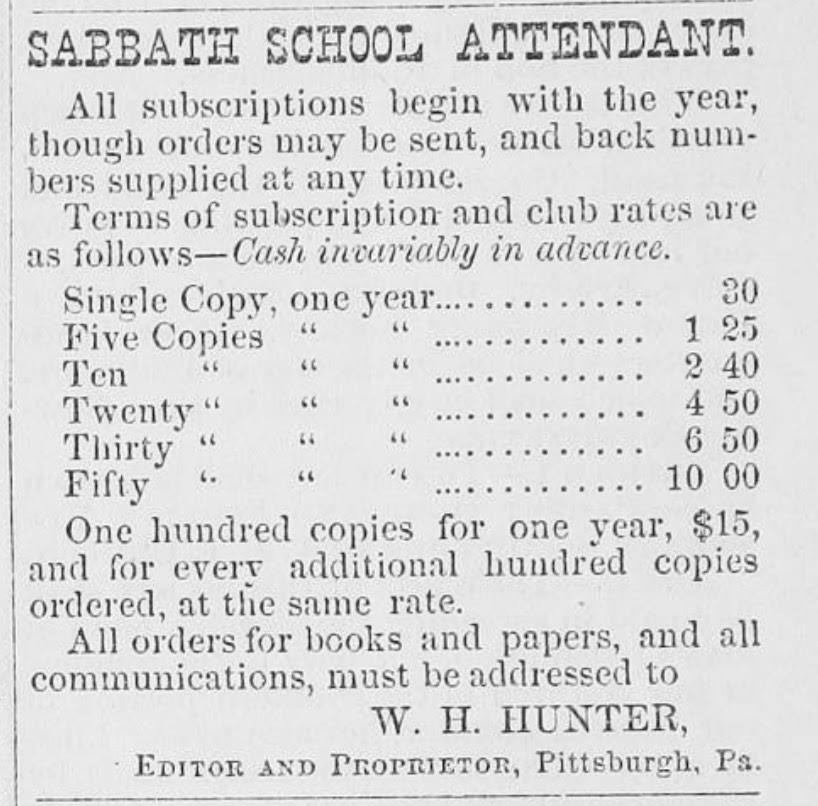
The Sabbath School Attendant edited by W. H. Hunter.
This children’s paper was created by an AME minister named William Hammett Hunter. It was published in Pittsburgh around 1869-1870. There are no known issues. I’m only aware of its existence because I saw an ad for it in other papers.
The Child’s Recorder published in 1870
This periodical was published by the African Methodist Episcopal Church in Philadelphia. There are no located issues published before 1880.
I currently have one lead. Dr. Julius Bailey referenced the first edition in his book titled Around the Family Altar. I have been unable to contact him to determine where he located the paper.
The Educator published in Fayetteville, NC.
Most editions of this periodical are available at the Library of Congress, but a few are missing from 1875: March 27, April 3, April 10, and April 17. The missing issues likely contain a few chapters of a short story by Charles Waddell Chesnutt titled: “Tom’s Adventure in New York.”
The Elevator published in San Francisco, CA.
Most editions of this periodical are available, but a few are missing. I’m interested in any issues published before 1900 not held by the California Digital Newspaper Collection.
The Freedman published in Boston, MA
The Freedman was an educational children’s periodical created to educate formerly enslaved black children. It began publication in 1864 and ceased at the end of 1869. It continued into 1870 under a new name: Our School and Home. All located issues have been digitized by Harvard University Library. I am looking for the following issues: January 1869, April-December 1869, any issues from 1870.
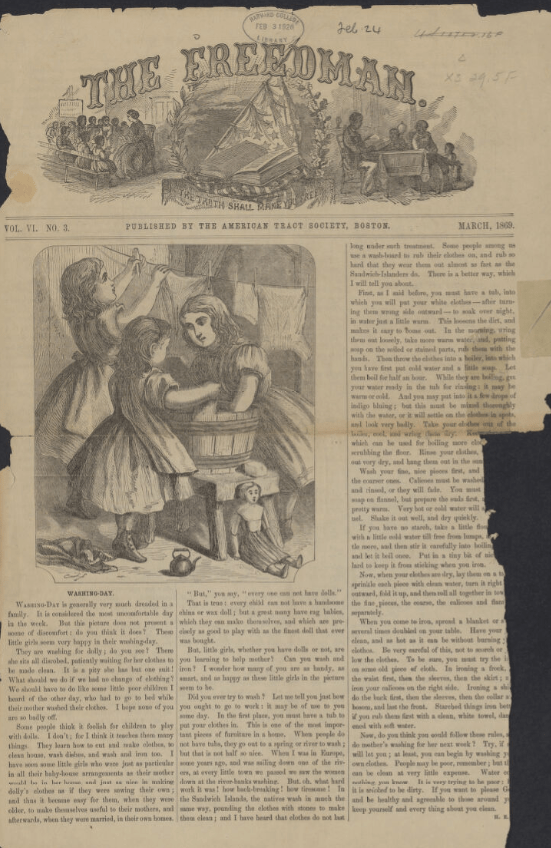
Image courtesy of Harvard
Our School and Our Home
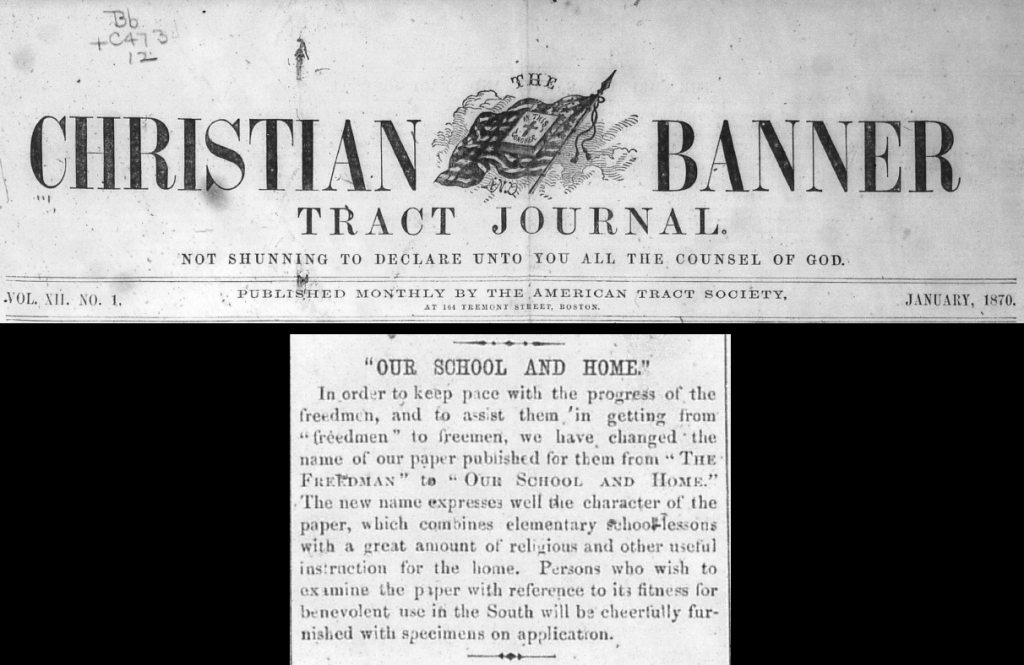
In January 1870, The Freedman was renamed to either Our School and Home or Our School and Our Home. I have not located any copies so I’ve been unable to confirm the title. At this point, it continued to be published by the American Tract Society in Boston. The January 1870 edition of Christian Banner Tract Journal announces the name change.
Morning Light
In January 1871, the paper first known as The Freedman had its title changed again. This time title became Morning Light and it was published by the American Tract Society in New York. That paper continued publication into the twentieth century. Apparently it was still used by black Americans at that time. A recipient said the paper was “beautiful, interesting and useful for all ages.”
Surviving issues are fairly scarce. I’m particularly interested in locating all issues from 1872 and February – December 1873.

American Tract Society.
The Child’s Paper published in foreign languages
During the 19th century, American Missionaries created children’s magazines all around the world. One such example is 小孩月报 which is latinized as Xiaohai Yuebao. It was printed in three different dialects: three different versions: Fuzhou (榕版), Guangzhou (穗版), and Shanghai (沪版). This paper began publication in either 1874 or 1875. Some issues from 1875 are available via the Bodleian Library. There are also some issues from the 1880s at Harvard Library. Some other issues from the 1870s-1880s are in the Late Qing dynasty periodical full-text database (1833-1911). I would love to find additional early editions.
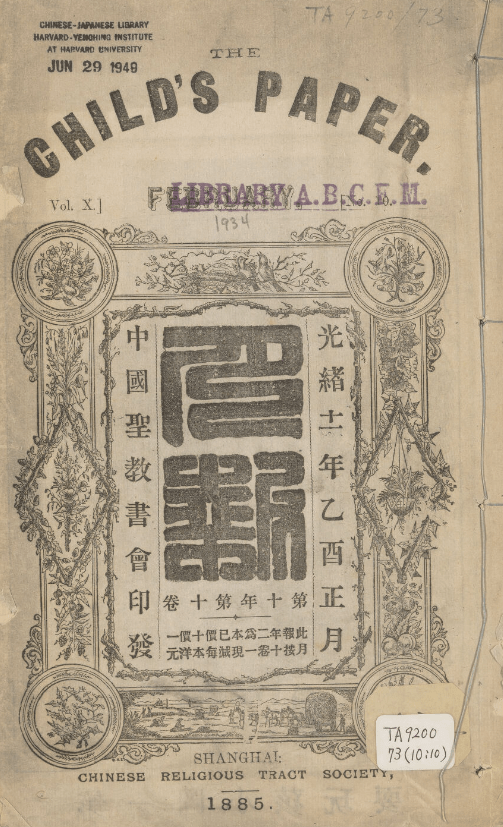
Image courtesy of Harvard
Other foreign language publications of interest are De Kinder-Vriend (Afrikaans) and Palier Nason (Tamil).
Herald of Peace / Guiding Star
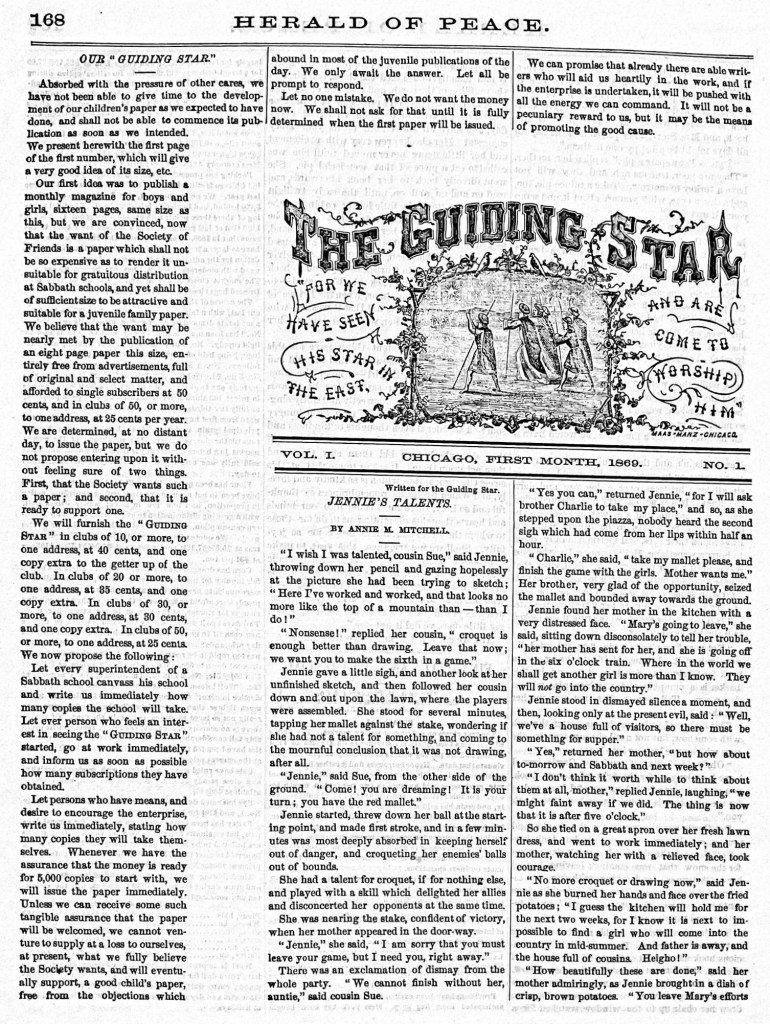
The Herald of Peace was a Quaker newspaper that began publication in January 1868. I’m not sure when it stopped publication, but the latest copy I’ve located is from August 1869. In January 1869, they announced that they would begin publishing a children’s paper titled The Guiding Star. They included an image of the first page next to the announcement. It’s not clear if a completed issue was ever made.
I’ve located several issues of the Herald of Peace at the American Antiquarian Society and the New York Historical Society but I’m still searching for more. I have not located any issues of The Guiding Star.
Photographs
Photo of sculpture by Edmonia Lewis
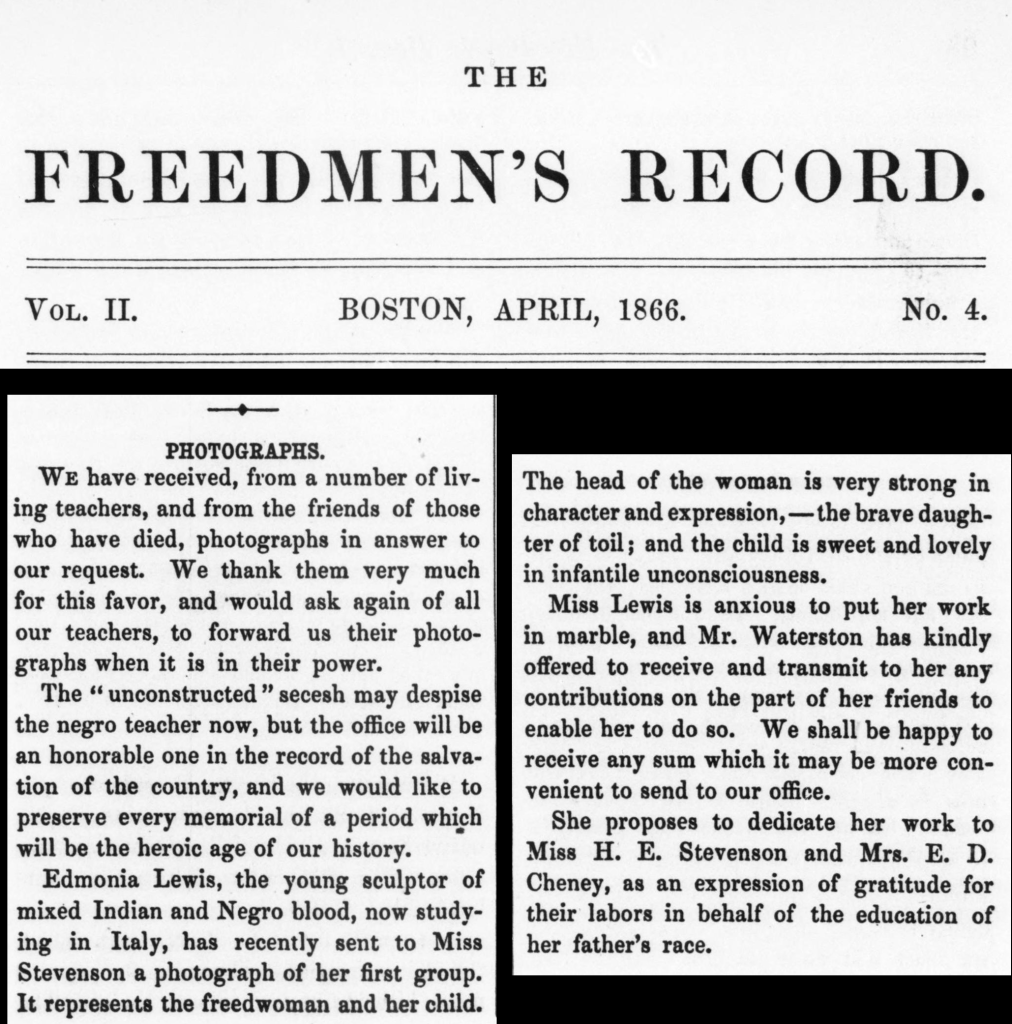
In 1866, Edmonia Lewis sent a photograph of the first sculpture she made in Rome. It was titled The Freedwoman and she wanted to dedicate it to Miss Hannah E. Stevenson and Mrs. Ednah D. Cheney. Mr. Waterston offered to collect donations so it could be done in marble. It’s not clear if this was ever actually made.
I know a photo was sent to Miss Stevenson. It seems likely that it would have been sent to Mr. Waterston too. A letter to Mrs. Maria W. Chapman seems to imply she might have received one too. Those are my only leads.
Blind Scipio
In 1866, Jane Briggs Smith sent pictures of two of her disabled black students to the New England Freedman’s Aid Society (NEFAS). She says their names were Scipio Horry and John King. Another source indicates his name might have been Scipio Rhea. I have searched through Jane Briggs Smith Fisk collection at the American Antiquarian Society, NEFAS records at Boston Public Library, NEFAS records at Massachusetts Historical Society and contacted the Perkins Archives. Samuel Gridley Howe got some books with raised letters for Scipio to read. I suspect Scipio’s photo might have been sent to Howe or others involved in blind education. One of the books was a Bible provided by the American Bible Society so I need to look into their other members too.

Jennie Carter
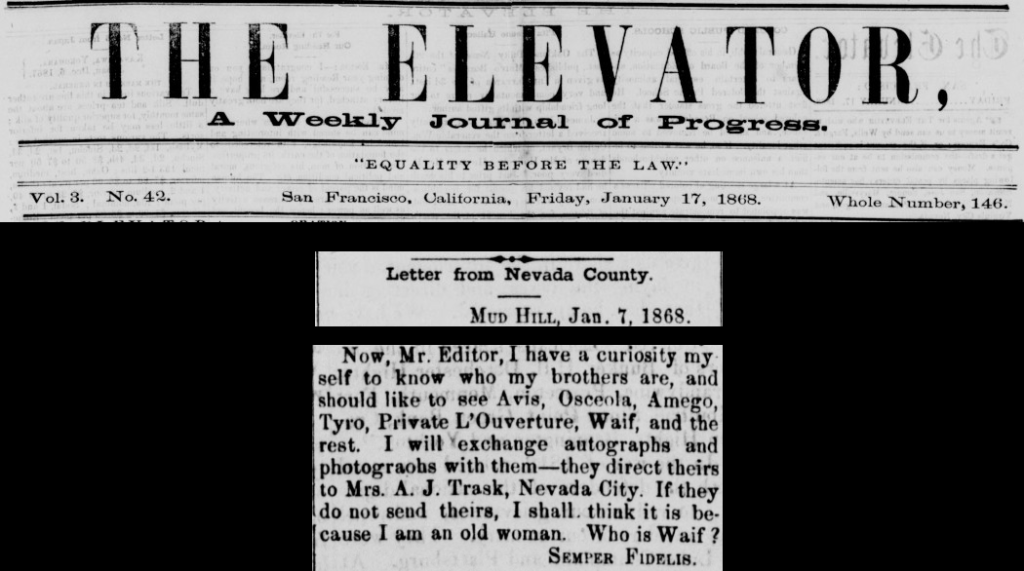
Mary Jane Carter lived in Nevada County, California in the mid to late 19th century. She is most noteworthy for regularly contributing articles to The Elevator under the pseudonyms Semper Fidelis and Joan Trask.
In her letter dated January 7, 1868 she asks about other contributors to The Elevator then states her wish to, “exchange autographs and photographs with them.” I do not know the names of all the contributors, as they too went by pseudonyms. The ones she lists are Avis, Osceola, Amego, Tyro, Private L’Overature, and Waif.
It also seems possible that the editor of the paper, Philip Alexander Bell, might have received a photo too.
Artwork
Ball’s Mammoth Pictorial Tour of the United States
In 1855, James P. Ball began exhibiting a giant moving panoramic painting of the United States. According to the accompanying pamphlet the complete painting was 4 yards tall and 600 yards long. Other advertisement indicate it was in 4 pieces, likely on giant rollers.
Painting of Joanna Donaldson Bronson
Charles Robert Leslie painted this portrait of Mrs. Oliver Bronson; her maiden name was Joanna Donaldson. It is logged in the Frick Photo Archive under catalog id 991013418379707141. According to the archive, it was last owned by “Mrs. James J. F. Martin (Mary Stuart Cromwell), great granddaughter of the subject, Asheville, North Carolina.” I did a bit of genealogical research, and Mrs. Mary Stuart Cromwell Martin was widowed and remarried John Stewart Barney in 1964. At the time of their marriage, they resided in Torremolinos, Spain. She was widowed again mere months after they were wed. Since she was born around 1908, she is presumably deceased at this point. But I’ve been unable to determine exactly when or where. I’m also not sure where the painting is.
Mrs. Bronson is of particular interest because she prepared the United States Primer, a simple textbook created to educate formerly enslaved black children.

Frick Photo Archive
 Lost History Books