Content note: this article mentions the death of a child and includes an illustration of a grave from 1862.
This is the first in a series of articles about obscure 19th century authors and educators. I hope to revise and expand them over time. This post was last edited on June 17, 2026.
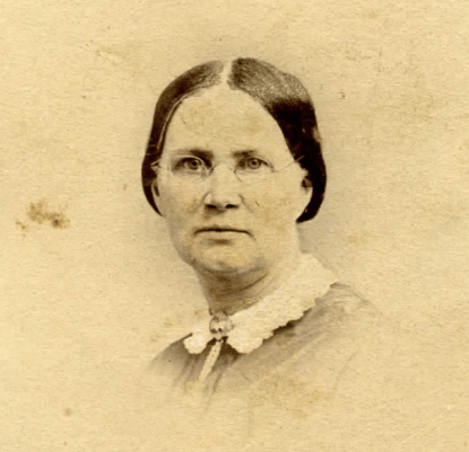
Image courtesy of her descendants
As many of you know, my interest in genealogy goes back more than a decade. It’s actually what launched my interest in history, but that is a story for a another time. While I spend most of my time working on historical research, I still relish the chance to do a genealogical deep dive. One such opportunity fell into my lap in the summer of 2023.
While preparing my essay on Literature for the Freedpeople I did some digging into a book titled: Step by Step, or Tidy’s Way to Freedom.1 I happened upon an excellent article by Dr. Laura Hakala titled: Tidying Up: Space, Place, and Abolitionism in Step by Step, or Tidy’s Way to Freedom.2 She expressed uncertainty about the author of the book because it was not listed on the title page. I happened to know that many books published by the American Tract Society in Boston didn’t list an author but named them in their annual reports. So I found the relevant citation and sent an email to Dr. Hakala.
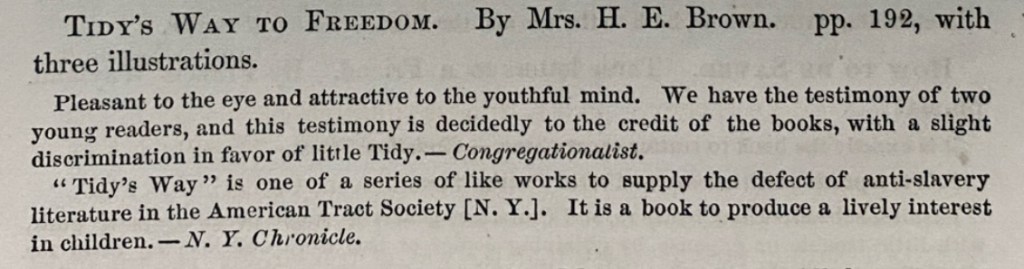
I was able to prove for certain that Step by Step was written by her. But that simply led us to a deeper question – who was Helen E. Brown? She used to be read by thousands of children, but now she is virtually unknown.4
When I got started, all I knew was that she lived in Brooklyn, New York and was an incredibly prolific author. Her name was quite common, so my genealogical research couldn’t definitively identify her. I narrowed it down to three women living in the greater New York City area:
Helen Ferris (1837-1917) who married Josiah Brown
Helen March (1819-1894) who married Moses Brown
Helen Evans (1851-1941) who married Morris Brown
It felt like I was going in circles for an eternity. So I decided read as much of her work as possible to find more hints about her identity. I re-read her articles published in The Child at Home and The Freedman. I also re-read Step by Step and John Freeman and His Family.5 But I couldn’t find any information to distinguish between these three ladies. So I decided to get copies of her other works.
I purchased a copy of Lonnie, Our Little Lamb6 in October 2023 and it was the key to solving this vexing mystery. The book is about the tragically short life of Helen Brown’s son, Alonzo Frederic Brown.
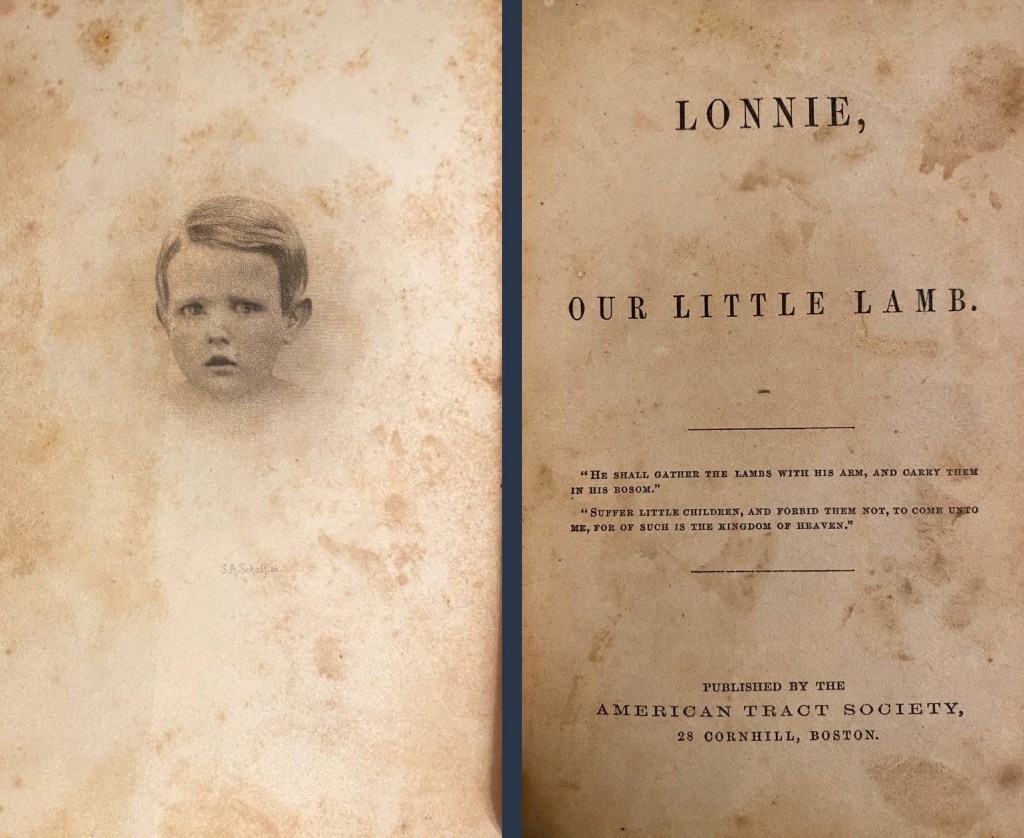
A biography of a deceased child may seem a bit odd to modern readers, but it was not unusual in the 1800s. For a detailed overview of this genre, see the article titled, A Communion of Little Saints, Nineteenth-Century American Child Hagiographies by Diana W. Pasulka.7 If you want to see other examples from my collection, see my prior post titled: Death and Dying in 19th Century Children’s Literature.8
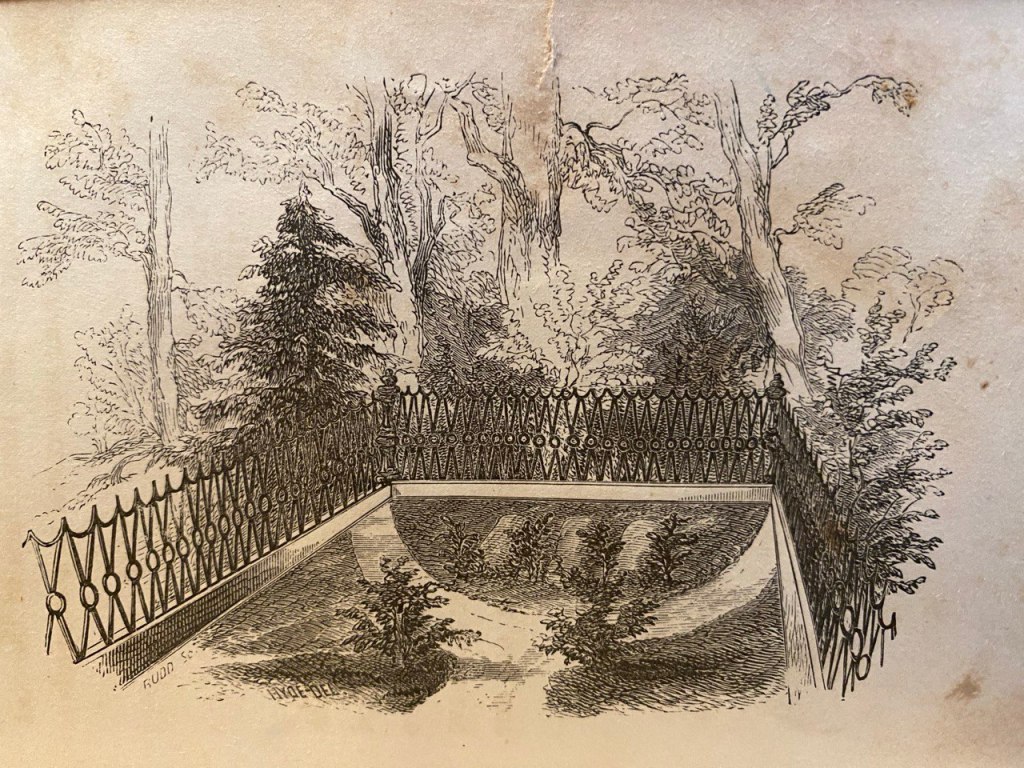
Lonnie includes an illustration of the boy’s grave and mentions he was buried at Greenwood Cemetery. Fortunately they have excellent digitized records so I was easily able to find his burial information.9 He was buried in lot number 5083 on March 5th, 1861. The ledger lists his address as 146 Columbia St.
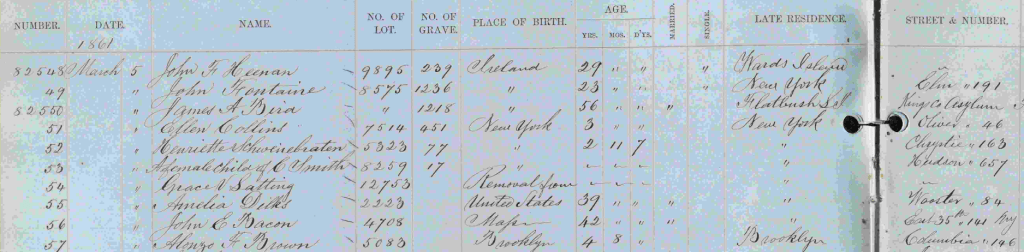
Once I had an address, it was very easy to cross reference the Brooklyn city directory to find information about his family. In 1862, Moses P. Brown lived at that address.
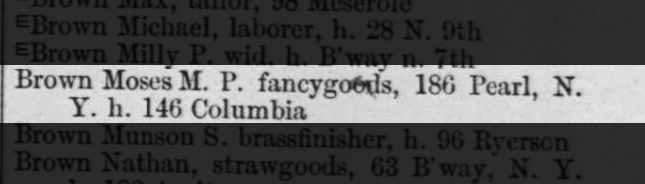
After I found Moses’ name, everything fell into place. I could easily find the whole family on the census and an assortment of vital records.10 Moses P. Brown married Helen Elizabeth March in 1840. They had many children, including young Lonnie. Both of them are buried in the same plot as him.
A few weeks after figuring this out, I got copies of three of her other books, all of which provided even more insight into her life.
In 1854, Brown published two books: The Three Darlings: Or, The Children of Adoption11 and The Bond Family: or, Self-Restraint and Self-Culture.12 Both were published by the American Female Guardian Society (AFGS).
The Bond Family appears to be heavily based on her real life in New York. It is particularly interesting to see her involvement in a local gym and disapproval of mainstream culture.
The Three Darlings is about her work with the AFGS. As the subtitle indicates, it is about three children that are adopted. Examining the content is outside the scope of this essay. My main takeaway was learning how involved she was involved in the AFGS. Finding this book helped me discover that she was one of the founding members and the editor of their periodical for decades.
Abroad; or, Lilian’s New School13 is a truly fascinating novel based on a trip she took to Europe in 1855. It appears to contain genuine excerpts of letters and diary entries she made during the trip. It also provides insight into her husband’s work since their travels are primarily business related.
By my current count, she wrote over 30 books and contributed to at least a dozen periodicals. It was ultimately her writing that provided the key to her identity. It took a few months, but Detective Ashlee always cracks the case!
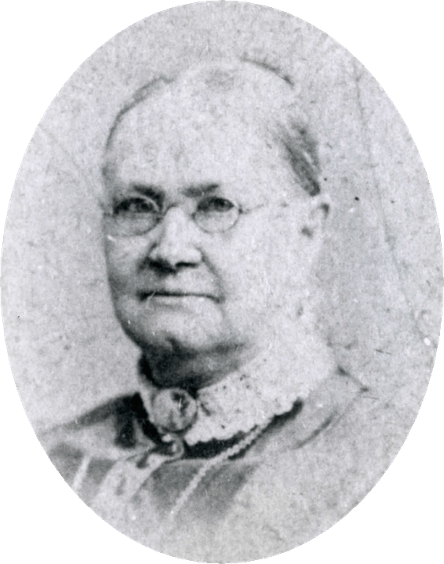
Image courtesy of her descendants
Below is a tabular bibliography of her known works. I’m also happy to provide this list as a spreadsheet or export from Zotero upon request. Please contact me if you have any corrections or additions.
Helen E. Brown’s Bibliography
Books
| Title | Organization | Year |
| The bond family: or, Self-restraint and self-culture. | American Female Guardian Society | 1854 |
| The Three Darlings: Or, The children of adoption | American Female Guardian Society | 1854 |
| Words of Counsel for the Wise Soldier | American Tract Society – Boston | 1861 |
| Words of Healing for the Sick Soldier | American Tract Society – Boston | 1861 |
| Words of Cheer for the Christian Soldier | American Tract Society – Boston | 1861 |
| Aunt Winnie’s Stories; Lottie’s Orange | American Tract Society – Boston | 1862 |
| Aunt Winnie’s Stories; The Crybaby | American Tract Society – Boston | 1862 |
| Aunt Winnie’s Stories; The Little Lost Kitty | American Tract Society – Boston | 1862 |
| Aunt Winnie’s Stories; The Two Sixpences | American Tract Society – Boston | 1862 |
| Fragrance from Crushed Flowers | American Tract Society – Boston | 1862 |
| Lonnie Our Little Lamb | American Tract Society – Boston | 1862 |
| Step by Step; or, Tidy’s Way to Freedom | American Tract Society – Boston | 1862 |
| The Mother and Her Work | American Tract Society – Boston | 1862 |
| The Winter School | American Tract Society – Boston | 1862 |
| Hymns for Mothers | American Tract Society – Boston | 1863 |
| The Medicine-Shelf | American Tract Society – Boston | 1863 |
| John Freeman and his Family | American Tract Society – Boston | 1864 |
| Walter Lightfoot’s Pictures | American Tract Society – Boston | 1864 |
| The Cup Bearer | American Tract Society – Boston | 1865 |
| Abroad; or, Lilian’s New School | American Tract Society – Boston | 1870 |
| Agnes in Search of Truth | American Tract Society – NY | 1872 |
| Lillie; or, The Little Christian’s Toilet | American Tract Society – NY | 1874 |
| Harry’s Bible and its Little Words | American Sunday School Union | 1879 |
| Ears to Hear | American Sunday School Union | 1879 |
| Eyes to See | American Sunday School Union | 1879 |
| Lips to Speak | American Sunday School Union | 1879 |
| Beautiful Hands and How to Use Them | American Tract Society – NY | 1882 |
| Our George or How to Grow Wise | Presbyterian Board of Publication | 1883 |
| A Good Catch; or, Mrs. Emerson’s Whaling Cruise | Presbyterian Board of Publication | 1884 |
| Our Golden Jubilee … 1834 to 1884 | American Female Guardian Society | 1884 |
| Lent Not Given | Presbyterian Board of Publication | 1885 |
| Mrs. Winchester’s Kitchen; or, The One Talent Improved | Presbyterian Board of Publication | 1887 |
| Hungry Little Lamb | Presbyterian Board of Publication | 1888 |
Periodicals
| Title | Publisher | Location |
| Advocate and Guardian | American Female Guardian Society | New York |
| Tract Journal | American Tract Society – Boston | Boston |
| Child at Home14 | American Tract Society – Boston | Boston |
| Christian Banner | American Tract Society – Boston | Boston |
| Sabbath at Home | American Tract Society – Boston | Boston |
| The Freedman | American Tract Society – Boston | Boston |
| Freedman’s Journal | American Tract Society – Boston | Boston |
| Sabbath at Home | American Tract Society – Boston | Boston |
| Illustrated Christian Weekly | American Tract Society – NY | New York |
| Well-Spring | Congregational Publishing Society | Boston |
| Presbyterian | William S. Martien & Co. | Philadelphia |
| Mothers’ Journal | M.G. Clarke | New York |
Footnotes
- Brown, Helen E. Step by Step; or, Tidy’s Way to Freedom. American Tract Society, 1862. https://archive.org/details/StepByStepTidysWay. ↩︎
- Hakala, Laura. “Tidying Up: Space, Place, and Abolitionism in Step by Step; or Tidy’s Way to Freedom.” The Lion and the Unicorn 45, no. 1 (2021): 62–80. https://muse.jhu.edu/article/804439/pdf. ↩︎
- Forty-Ninth Annual Report of the American Tract Society Presented at Boston, May 27, 1863. American Tract Society, 1863. https://archive.org/details/ATS-Boston-1863. ↩︎
- Helen E. Brown was a regular contributor to the Child at Home published by the American Tract Society in Boston from December 1859 to sometime in the 1870s. She also contributed to The Freedman. Monthly circulation numbers are included below in Appendix A. ↩︎
- Brown, Helen E. John Freeman and His Family. Freedman’s Library 1. American Tract Society, 1864. ↩︎
- Brown, Helen E. Lonnie Our Little Lamb. American Tract Society, 1862. https://archive.org/details/LonnieLamb. ↩︎
- Diana W. Pasulka, “A Communion of Little Saints: Nineteenth-Century American Child Hagiographies,” Journal of Feminist Studies in Religion 3, no. 2 (2007): 51–67. https://www.jstor.org/stable/20487898 ↩︎
- “Death and Dying in 19th Century Children’s Literature.” Lost History Books, September 30, 2024. https://losthistorybooks.com/2024/09/29/death-and-dying-in-19th-century-childrens-literature/. ↩︎
- Here is the link to the digitized records of Green-Wood Cemetery in Brooklyn. https://www.green-wood.com/burial-and-vital-records/ . Lonnie is buried in lot 5083. ↩︎
- I have built a public family tree for Helen E. Brown on Ancestry. You can view it here: https://www.ancestry.com/family-tree/tree/194487933/ ↩︎
- Brown, Helen E. The Three Darlings: Or, The Children of Adoption. American Female Guardian Society, 1854. https://archive.org/details/three-darlings. ↩︎
- Brown, Helen E. The Bond Family: Or, Self-Restraint and Self-Culture. American Female Guardian Society, 1854. ↩︎
- Brown, Helen E. Abroad; or, Lilian’s New School. American Tract Society, 1870. https://catalog.hathitrust.org/Record/009429340. ↩︎
- Her contributions to The Child at Home included articles, short stories, poems, and hymns. I had a selection of her hymns transcribed and they are available on Musescore or via pdf upon request. https://musescore.com/user/77419174 ↩︎
- Forty-Sixth Annual Report of the American Tract Society Presented at Boston, May 30, 1860. Vol. 46. American Tract Society, 1860. Page 9. https://babel.hathitrust.org/cgi/pt?id=hvd.ah3iqq&view=1up&seq=7. ↩︎
- Forty-Seventh Annual Report of the American Tract Society Presented at Boston, May 29, 1861. Vol. 47. American Tract Society, 1861. https://babel.hathitrust.org/cgi/pt?id=hvd.ah3iqr&view=1up&seq=7.
The Child at Home is listed combined with The Tract Journal at 205,000 copies monthly on page 17. ↩︎ - Forty-Eigth Annual Report of the American Tract Society Presented at Boston, …1863. Vol. 48. American Tract Society, 1862.
On page 26, The Child at Home is listed with a total number printed of 1,615,000 that year which comes out to 134,583 monthly. ↩︎ - Forty-Ninth Annual Report of the American Tract Society Presented at Boston, May 27, 1863. Vol. 49. American Tract Society, 1863. https://archive.org/details/ATS-Boston-1863.
On page 10, The Child at Home is listed with a total number printed of 1,595,000 that year which comes out to 132,916 monthly. ↩︎ - Fiftieth Annual Report of the American Tract Society Presented at Boston, May 25, 1864. Vol. 50. American Tract Society, 1864. https://babel.hathitrust.org/cgi/pt?id=mdp.39015034588650&view=1up&seq=1.
On page 22, The Child at Home is listed with a total number printed of 1,679,000 that year which comes out to 139,917 monthly.
The Freedman is listed with a total number printed of 180,000 that year which comes out to 15,000 monthly. ↩︎ - Fifty-First Annual Report of the American Tract Society Presented at Boston, May 31, 1865. Vol. 51. American Tract Society, 1865. https://catalog.lib.uchicago.edu/vufind/Record/12749597.
On page 16, The Child at Home is listed with a total number printed of 2,035,000 that year which comes out to 169,583 monthly.
The Freedman is listed with a total number printed of 750,000 that year which comes out to 62,500 monthly. ↩︎ - Fifty-Second Annual Report of the American Tract Society Presented at Boston, May 30, 1866. Vol. 52. American Tract Society, 1866. https://babel.hathitrust.org/cgi/pt?id=mdp.39015034588643&view=1up&seq=3.
On page 8, The Child at Home is listed with a total number printed of 2,037,000 that year which comes out to 169,750 monthly.
The Freedman is listed with a total number printed of 648,000 that year which comes out to 54,000 monthly. ↩︎ - Fifty-Third Annual Report of the American Tract Society Presented at Boston, May 29, 1867. Vol. 53. American Tract Society, 1867. https://babel.hathitrust.org/cgi/pt?id=mdp.39015034588635&view=1up&seq=3.
On page 15, The Child at Home directly lists an average monthly circulation of 174,000.
The Freedman is not listed individually. ↩︎ - Fifty-Fourth Annual Report of the American Tract Society Presented at Boston, April 30, 1868. Vol. 54. American Tract Society, 1868. https://babel.hathitrust.org/cgi/pt?id=mdp.39015034588627&view=1up&seq=1.
On page 33, The Child at Home is listed with a total number printed of 2,201,000 that year which comes out to 183,417 monthly.
The Freedman is listed with a total number printed of 461,000 that year which comes out to 38,417 monthly. ↩︎ - Fifty-Fifth Annual Report of the American Tract Society Presented at Boston, April 30, 1869. Vol. 55. American Tract Society, 1869. https://babel.hathitrust.org/cgi/pt?id=mdp.39015034588619&view=1up&seq=1.
On page 17, The Child at Home is listed with a total number printed of 2,088,000 that year which comes out to 174,000 monthly.
The Freedman is listed with a total number printed of 461,000 that year which comes out to 38,417 monthly. ↩︎
Appendix A – Average monthly circulation for The Child at Home and The Freedman.
 Lost History Books