For the past few years, I’ve been deeply interested in the literary career of Anne Maria Mitchell Payne (1847-1929). I’m primarily focused on her books for freed people, but I have explored all of her writing to better contextualize those works. The second book she published is a rather unusual little one titled: Paul Kent, the Choir Boy.1

Photo taken by me in 2024
I had the pleasure of seeing the only known copy at the Library of Congress in December 2024. Paul Kent is a sentimental story about a pair of choir boys that serve at a large Episcopal church. The church is never named, but there is good reason to believe it’s based on St. Mark’s Episcopal Church in Philadelphia. The frontispiece of the book is clearly based on that church.2 During the 19th century, the Episcopal church was deeply divided over ritualism. If you want to understand the background of this, you can dig into the history of the Oxford Movement, Tracts for the Times, and Hymns Ancient and Modern. For the sake of brevity, all you need to know is that relatively few American churches embraced the “high church” ritualism depicted in Paul Kent. St. Mark’s Philadelphia was a notable early adopter.3
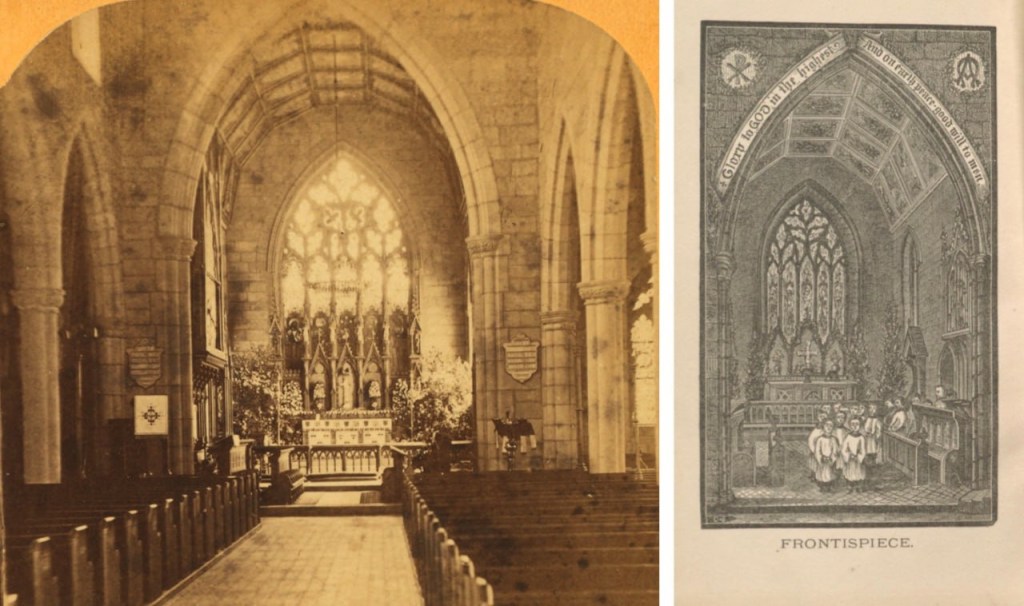
A few things make Paul Kent rather unique. During the 19th century, the vast majority of religious kid’s books were made by non-denominational publishing houses: The American Tract Society and the American Sunday School Union. An assortment of denominational publishing houses also existed: The American Baptist Publication Society, The Presbyterian Board of Publication, The Methodist Book Concern, The Congregationalist Book and Tract Society, Tract Society of Friends, The Lutheran Board of Publication, etc. While many of these publishers created children’s books, the stories rarely included the doctrinal and practical differences they had from other Christian denominations.
Paul Kent stands apart from this crowd. Mitchell clearly states that she wants children to learn, “to love and venerate our ancient and most beautiful Liturgy.” The book is suffused with the doctrine and traditions of the Episcopal church. The King James Bible, the Book of Common Prayer and the authorized hymnal are quoted extensively.

I’ve only found one other 19th century author that explores the Book of Common Prayer within children’s books: Frances Irene Burge. She wrote a trilogy of books that explore different parts of the Book of Common Prayer. The Bishop and Nannette is about the daily morning prayer service.4 Miss Bent is about the Litany.5 Cousin Minnie is about Holy Communion.6 These books have all been digitized so I’ve included links above and in the footnotes.
Since there is only one extant copy of Paul Kent, I’ve transcribed it to make it more accessible. I hope to add it to Project Gutenberg in the future. But for now, please contact me to receive a digital copy. I hope someone ends up reading it; I would love to discuss it with someone.
- Mitchell, Anne M. Paul Kent the Choir Boy. Richard McCauley, 1869. Library of Congress. https://archive.org/details/PaulKent.
Please contact me if you would like a transcribed and annotated copy. ↩︎ - I am deeply indebted to Michael Krasulski for identification of the church and digital archival records on his blog: https://philadelphiastudies.org/ ↩︎
- For more information about the history of St. Mark’s Episcopal Church in Philadelphia and its relation to the Oxford Movement, see their website: https://www.saintmarksphiladelphia.org/history ↩︎
- Smith, Frances I. B. Bishop and Nannette. Thomas Whittaker, 1873. https://www.google.com/books/edition/The_Bishop_and_Nannette/kg5CAQAAMAAJ. ↩︎
- Smith, Frances I. B. Miss Bent or At His Footstool. Thomas Whittaker, 1881. https://babel.hathitrust.org/cgi/pt?id=osu.32435076163153. ↩︎
- Smith, Frances I. B. Cousin Minnie or the Feast of Life. Thomas Whittaker, 1880. https://archive.org/details/CousinMinnie. ↩︎
 Lost History Books