This is part of a series of short biographies. I hope to continue to revise and expand them. This article was initially posted on June 18, 2026 and last edited on June 23, 2026.
One of my most inspiring research subjects is a man named William Forster Mitchell. I’ve known he was named after a famous Quaker abolitionist for years, but I didn’t know if he ever reflected upon that fact – until now. Pulling on that thread revealed an unexpectedly profound story that stretches across the Atlantic ocean.
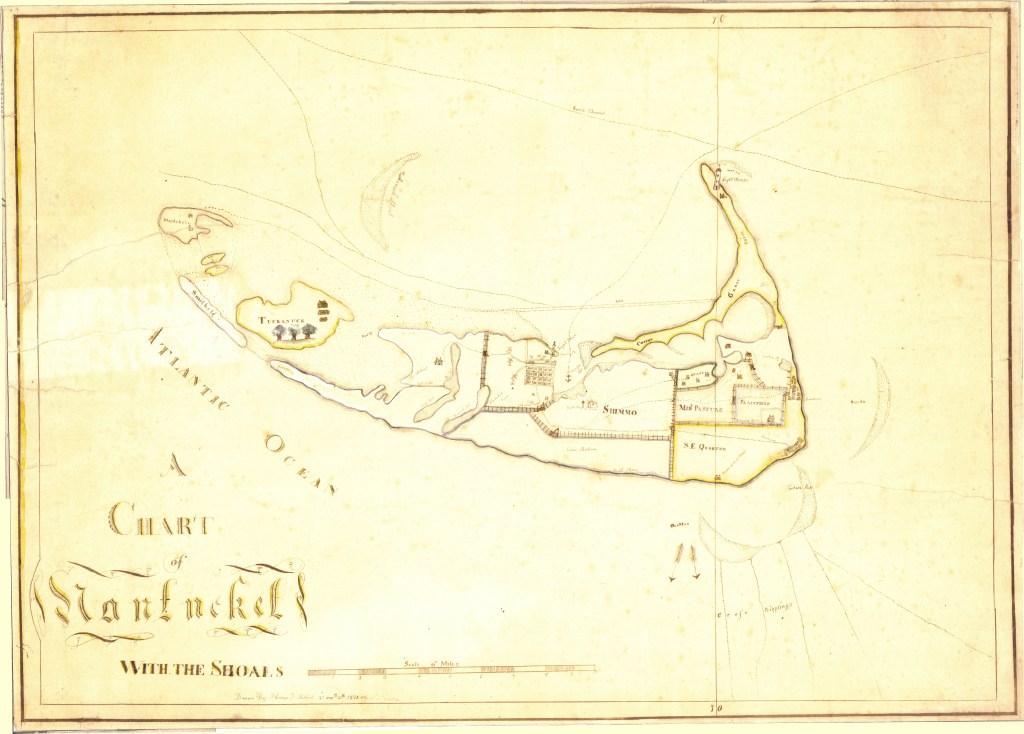
Image Courtesy of the Nantucket Historical Association 1
In 1824, an English Quaker named William Forster visited the small island of Nantucket off the coast of Massachusetts.2 He had been traveling all through the United States, visiting Quaker communities, preaching the gospel, and advocating for the abolition of slavery. He must have made a distinct impression on William Mitchell and his wife Lydia; they named their next child after him. William Forster Mitchell was born on August 31, 1825.3 With time, he would follow in the footsteps of his namesake.
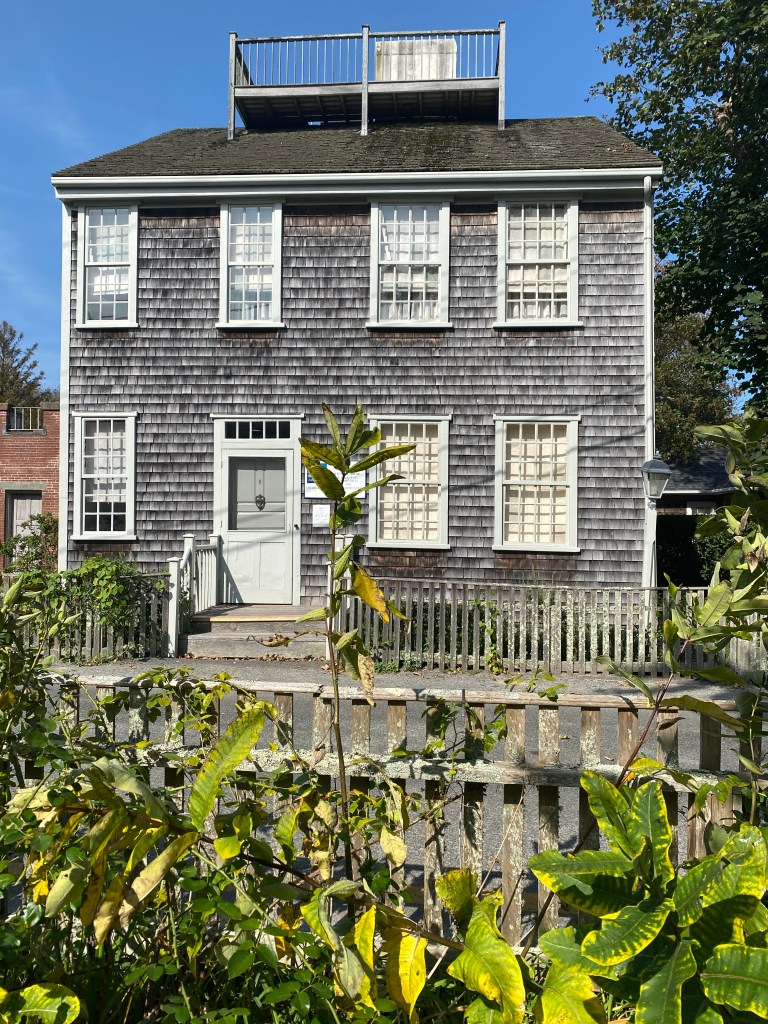
Photo taken by me in 20234
Mitchell’s early life was fairly ordinary.5 He grew up in the lovely house on Vestal Street which is depicted above. He married Charlotte Dow in 1846. They had a daughter the following year: Anne Maria Mitchell. She is named after two of his sisters. Later in 1847, his sister Maria Mitchell would discover the comet that made her famous. But William Forster Mitchell’s career would remain grounded. He was a teacher in Massachusetts 1849-1852.6 Then he moved to Philadelphia and continued to work as an educator.
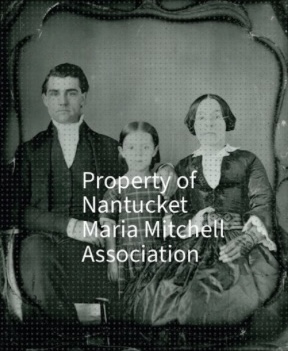
and Charlotte Dow Mitchell.
Image courtesy of the Maria Mitchell Association7
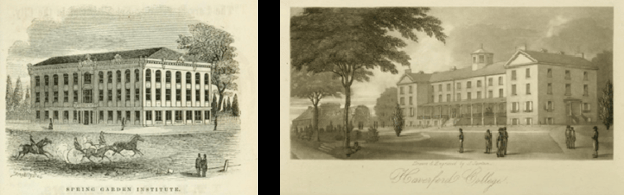
While in Philadelphia, he was principal of a Quaker school called the Spring Garden Institute from roughly 1854 to 1861.8 Then he worked at Haverford College as the superintendent for one school year.9 I’m not sure when, but he was also principal of Roberts Vaux Public School during a period of instability.10
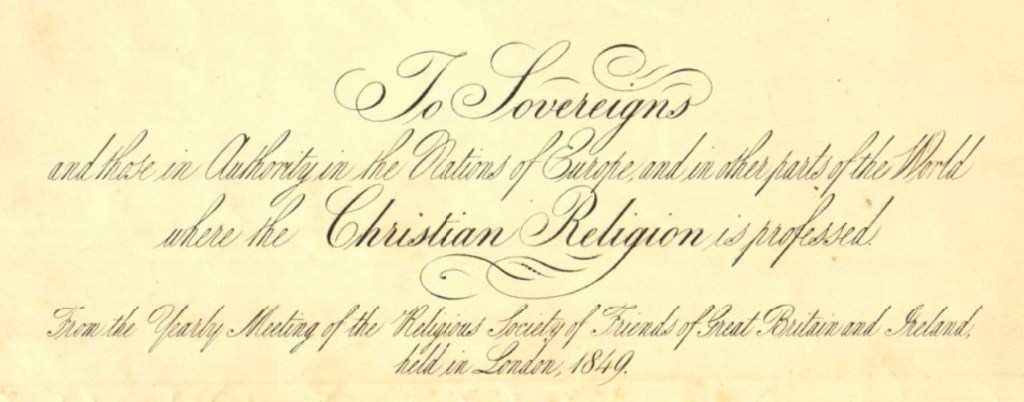
Across the Atlantic Ocean, William Forster remained devoted to the cause of abolition. He was an early member of British and Foreign Anti-Slavery Society and attended the World Anti-Slavery Convention in 1840. He worked for abolition at home and abroad. In 1849, the London Yearly Meeting prepared an address to: Sovereigns and Those in Authority in the Nations of Europe, and in Other Parts of the World Where the Christian Religion is Professed. Forster volunteered to present it to leaders all across Europe. He visited a remarkable number of places: Hanover, Sweden, Denmark, Prussia, Switzerland, Italy, France, Spain, and more.11
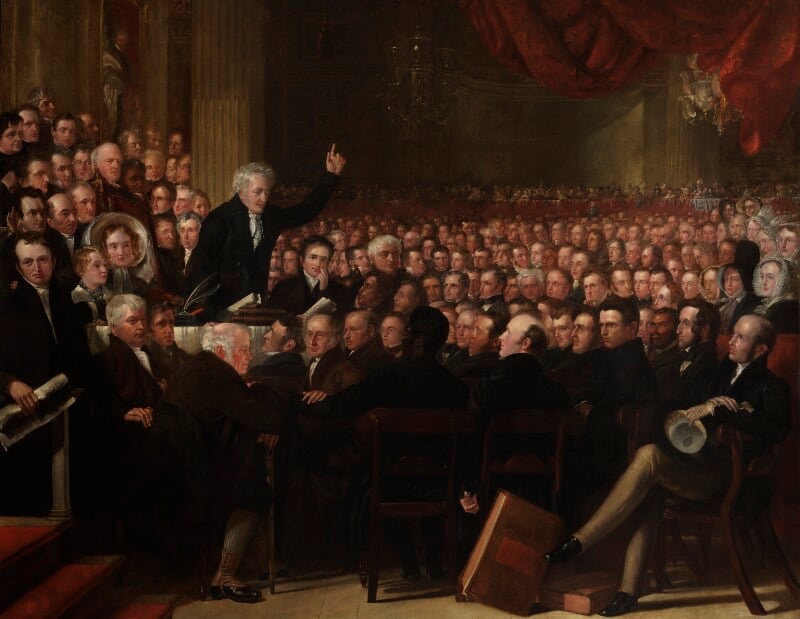
Image Courtesy of the National Gallery12
In 1853, the London Yearly Meeting resolved to continue to advocate for abolition abroad by taking the address to the president of the United States and as many governors as possible. Forster volunteered and returned to America in 1853 to once again advocate for abolition.
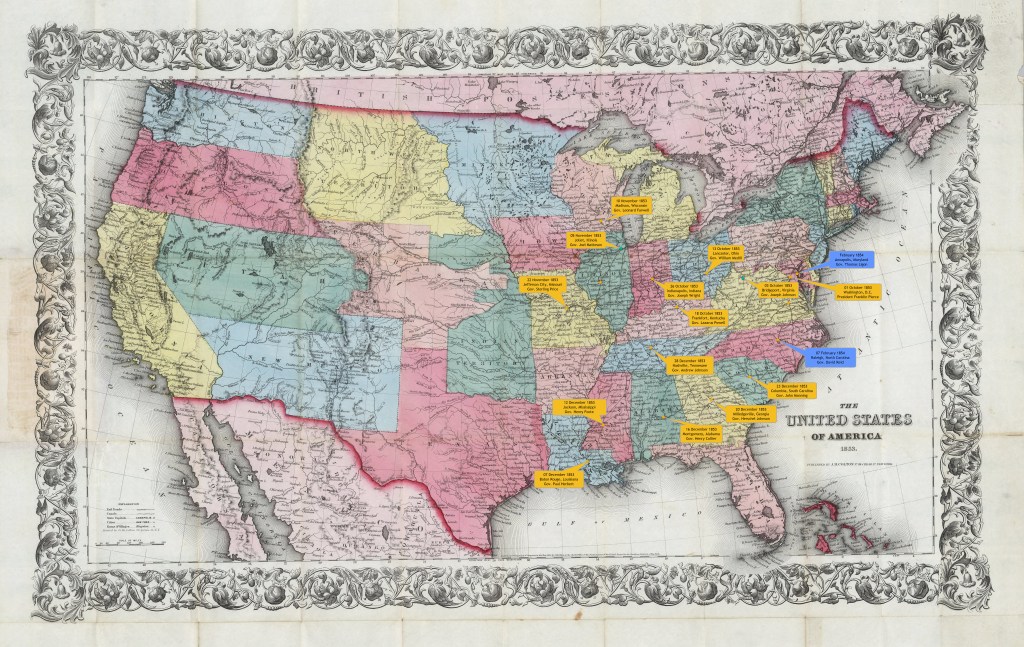
Original Image Courtesy of Stanford13
The scope of his travel is mind boggling. Forster began his work by meeting with President Franklin Pierce in Washington, D.C. He proceeded to visit the governors of several states: Virginia, Ohio, Kentucky, Indiana, Illinois, Wisconsin, Missouri, Louisiana, Mississippi, Alabama, Georgia, and South Carolina. His last stop was Tennessee, where he spoke to Governor Andrew Johnson who would become president some years later. Johnson was polite, but dismissive. Forster became ill the following week and died on January 27, 1853. He is buried in Friendsville, Tennessee. Though they were weighed down with grief, his brother Josiah Forster and the other two gentlemen continued their mission. They visited several more governors before returning to England with a detailed report.14 Just a few years later, William Forster Mitchell would begin his own labors for Black people.
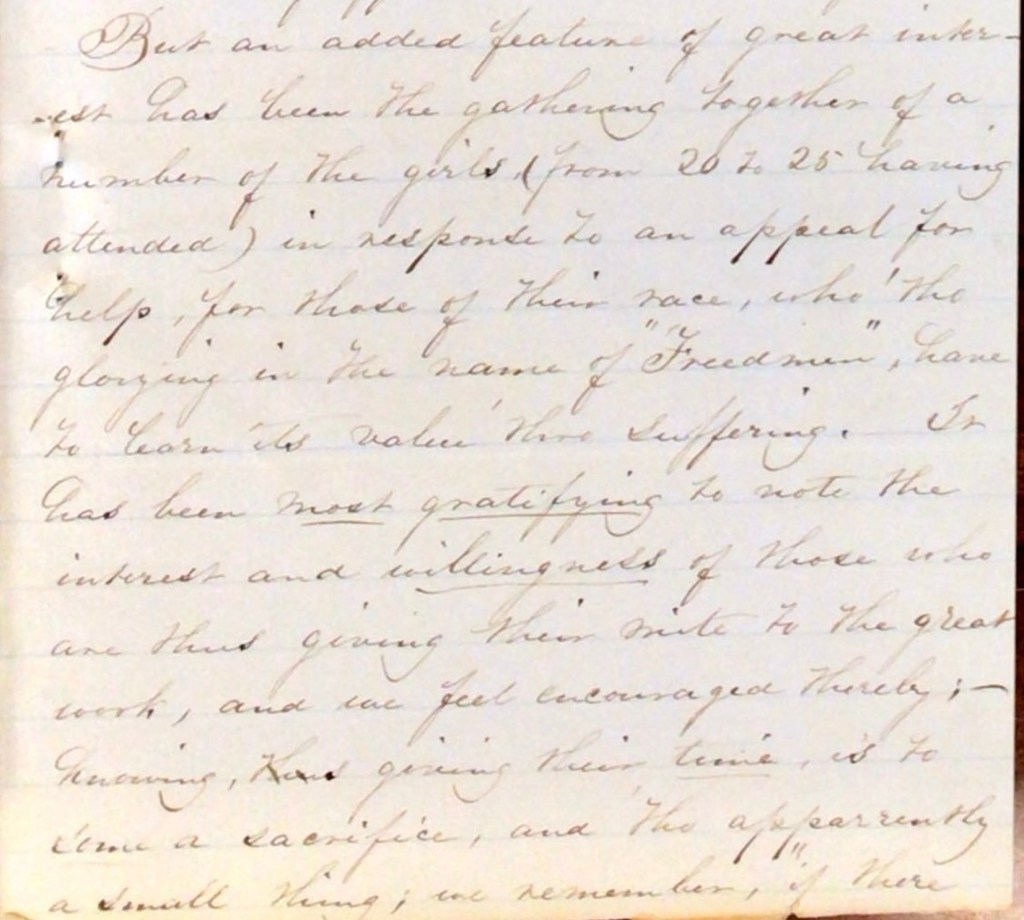
Mitchell’s first endeavor was quite modest. He was already an experienced educator when he began leading a failing project called the Bethany Mission for Colored People around 1856.16 He was able to stabilize it within just a few years. The scope of the mission is detailed in the 1860 Annual Report and monthly meeting minutes.17 A small note from February 10, 1864 is particularly interesting. A group of students began gathering weekly to sew clothes for newly freed black Americans in refugee camps. It’s so beautiful that impoverished people were enthusiastic to donate their time and talents to those even more desperate than them.
Just a few months after this, William Forster Mitchell began caring for freedmen more directly. A branch of the American Freedmen’s and Union Commission (AFUC) called the Pennsylvania Freedmen’s Relief Association (PFRA) tasked him with organizing schools in Tennessee and Alabama. In 1865, he founded an orphanage in Nashville. In his own words:
Nearly every Freedmen’s Association has an Orphan House. One such is under my care. It is in Nashville. I have written of it, talked of it, and prayed for it. Now I have named it,—named it for one whom I never saw, but whose name I bear;—named it for him, because his life was on the side of these people, and he yielded it up cheerfully for them. He sleeps in a Tennessee grave, but the love he bare for the Coloured race still lives, and the orphan children of Nashville will learn to associate the name of William Forster with the birthday of their freedom.19
It took a Herculean effort to support a fledgling orphanage in the middle of a refugee crisis, but somehow he made it work. He received contributions from across the USA, England, Ireland, and Scotland. The aid provided material help to the refugees, but it also lifted William’s morale. The following excerpt describes the receipt of goods from the Bethany Mission for Colored Children in Philadelphia:
This afternoon New Bethany Sabbath school is in session. I am not well enough to be there. Our Stevenson teacher and one of the ladies are holding it, and I hope are having a good time. Yesterday was a day of great trial to us, on account of the misery we were forced to witness. In taking clothing from a large box my eyes were gladdened by the sight of the words ‘Bethany Mission for colored children, Philadelphia.’ There was their mark, and I carefully selected all the goods having this imprint, and put them by for the orphans whom we are to gather in this week. Children left all alone in the world, who are daily pushed away from the stove, several of whose number have laid down to die during the past ten days, will wear these garments. While I am writing this there is so much suffering within rifle shot of my home, that my heart faints within me.20
He worked tirelessly for three years, establishing schools, training teachers, and advocating for government supported public schools. His wife and daughter worked along side him for two of those years. Public schools were established in Tennessee in 1867, and so Mitchell considered his work there to be complete.21
Around that time, some English Quakers invited him to Great Britain for a fundraising tour. After much deliberation, he accepted.22 He departed from Boston on the steamship Cuba and arrived in Liverpool on August 12, 1867.23 The itinerary was very intense; he traveled hundreds of miles over six months. Along the way he met with Josiah Forster, the brother of his namesake.24 On January 5, 1868, Josiah oversaw his farewell meeting at Devonshire House where they wished for his safe return home and recognized, “…his success in the high and responsible mission of labouring for the social and Christian elevation of the coloured people of the United States of America.”25
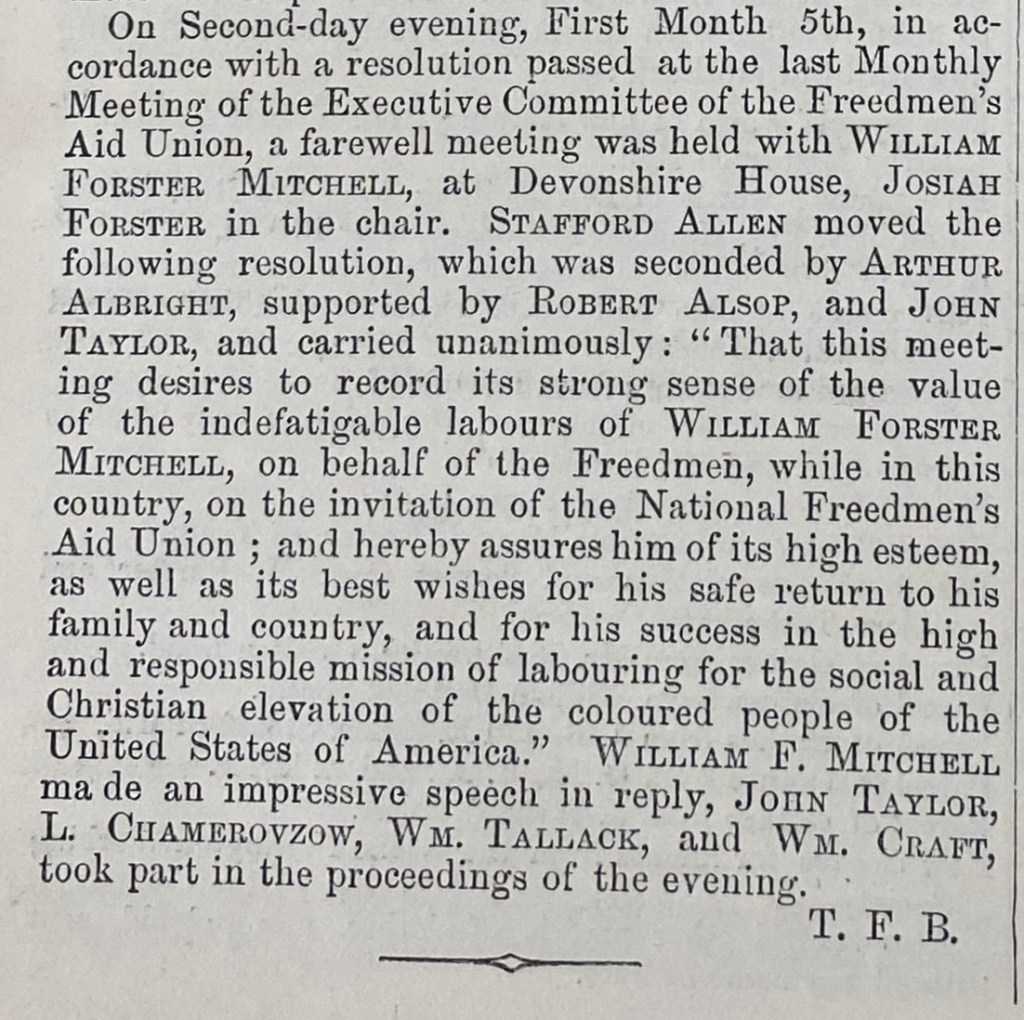
Mitchell spoke at 84 meetings all across Great Britain. He raised £5,000 which was equivalent to nearly $38,000. Adjusted for inflation, that is over $850,000. For the following two years, he oversaw its distribution; it was used to sustain and expand teacher training efforts across the United States.27 At the end of 1869, the AFUC officially disbanded but he continued to work for the freed people.
The remainder of Mitchell’s life was dedicated to an assortment of educational and charitable pursuits. He was employed by the Freedmen’s Department of the Presbyterian Committee of Home Missions in 1870-1871.28 In 1872 he became a city missionary in Lynn, Massachusetts for a few years.29 From 1877 to 1879, he was superintendent of the Children’s Home in Cincinnati, Ohio.30 He resigned in April of 1879 to work as a city missionary there for a few years.31 Providing aid to the needy was his top priority but he also organized fun excursions.32 One of his major accomplishments was distributing aid during the devastating 1883 Ohio river flood.33
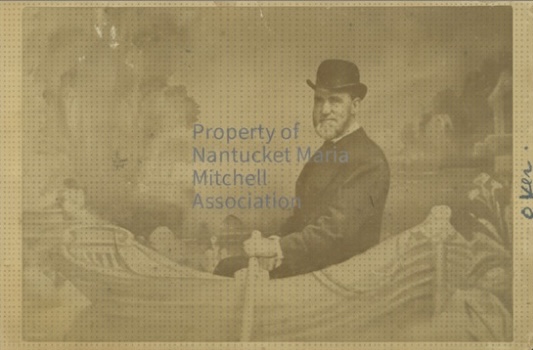
Image courtesy of the Maria Mitchell Association
Later in 1883, he resigned and moved to Washington, D.C. to take a job at Howard University. 35 He established the industrial department at the university, which taught a variety of trades: “Tin and Iron Work, Printing, Shoemaking, Tailoring, Carpentry and Cabinet Work, Needlework, and Typewriting.” He resigned from Howard in 1888. 36
After that he served the community via the “Office of Free Counsel for Colored People” in New York.37 He eventually retired to Nantucket, MA and lived with his brother, Henry Mitchell. The year before he died, his brother reflected on his legacy:
What will Uncle Forster’s surprise be when he reaches another world and is received by a great crowd of friends. He has never expected any return for all the work he has done – for he has always served the very poorest people and the most miserable in mind as well as purse. In short he lived for the sake of those who were helpless and despised. Some folks turned up their noses at his ‘want of taste’ in going down amongst the vulgar to live and work – but that didn’t trouble him because it never occured to him that anyone could think wrong of him – or think much about him in any way. He was just a servant to those who needed him most. He is a great hero – and nobody knows it – except God!38
William Forster Mitchell died on June 16, 1892 after a long and painful illness. A couple months later, there was a large memorial service to celebrate his life.39
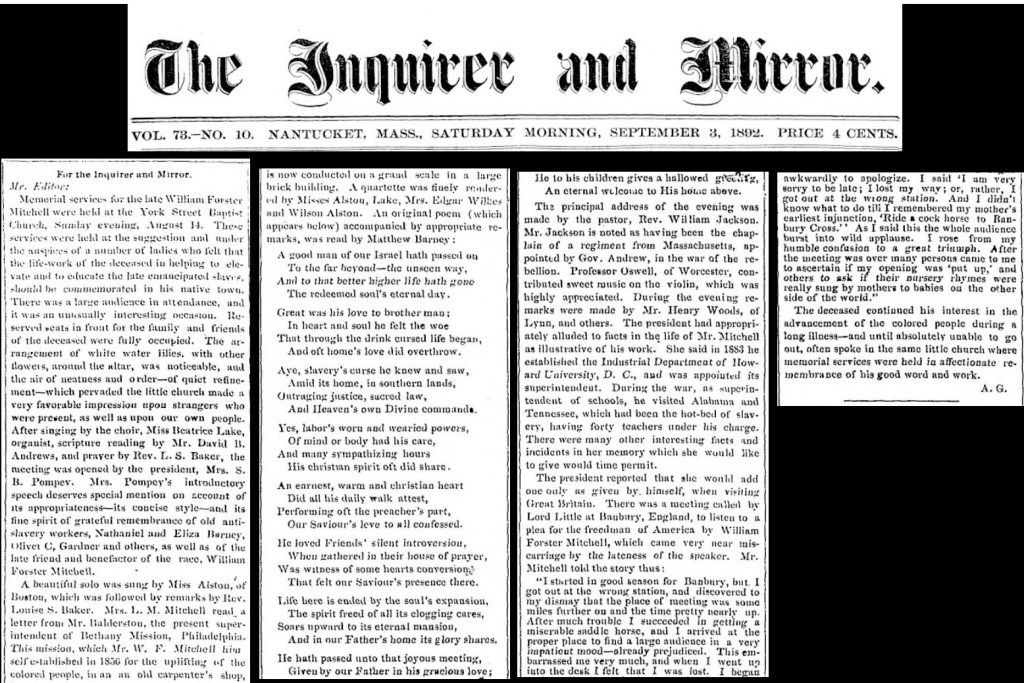
The gathering was a beautiful tribute to his incredible life. A diverse crowd of friends and family gathered in the York Street Baptist Church on Sunday, August 14, 1892. The proceedings were run by the wife of a black veteran named Mrs. Susan B. Pompey.41 Other participants were a white Congregational minister named Rev. Louise S. Baker and a black Baptist minister named Rev. William Jackson. His nephew, Matthew Barney, read an original poem in his honor. Another relative read a letter from Mr. Balderston, the superintendent of the Bethany Mission in Philadelphia. Even in death, William F. Mitchell was still uniting people across race, class, and denomination. I hope that you, dear reader, will now be inspired to continue that legacy.
In my next post, I’ll write about the illustrious career of his daughter, Anne Maria Mitchell Payne, and the books she wrote for freed people. Then I’ll write about the research trips I took to learn more about their lives. I’ve been chasing their stories across Alabama, D.C., Illinois, Massachusetts, Ohio, Tennessee, and across the ocean in England. I can’t wait to tell you all about it. Thanks for reading and stay tuned!
Footnotes
- Mitchell, Thomas F. A Chart of Nantucket with Shoals. n.d. Nantucket Historical Association. https://nantuckethistory.org:443/permalink/?key=6000_m7746.
↩︎ - Information about his travels in America in 1823-1824 are from his memoirs which were published posthumously:
Forster, William. Memoirs of William Forster. Vol. 1, edited by Benjamin Seebohm. Alfred W. Bennett, 1865. https://www.google.com/books/edition/Memoirs_of_William_Forster/Gja0AAAAMAAJ?hl=en&gbpv=1.
Forster, William. Memoirs of William Forster. Vol. 2, edited by Benjamin Seebohm. Alfred W. Bennett, 1865. https://www.google.com/books/edition/Memoirs_of_William_Forster_ed_by_B_Seebo/VUEBAAAAQAAJ. ↩︎ - I have built a family tree on ancestry, with links to an assortment of primary sources. You can access it here:
https://www.ancestry.com/family-tree/tree/194487430/family?cfpid=282538121453&fpid=282538121454 ↩︎ - His childhood home is preserved as a museum by the Maria Mitchell Association. I was fortunate enough to visit in both 2023 and 2024. I’ve also met a few of Mitchell’s descendants. ↩︎
- When I was just beginning to learn about William Forster Mitchell, I found the following manuscript by Elizabeth Yager to be extremely helpful:
Elizabeth F. “Biography of William Forster Mitchell.” n.d. Elizabeth F. Yager Collection / MS294 / Folder 2. Nantucket Historical Association. ↩︎ - Mitchell, William F. “William Forster Mitchell to James Miller McKim.” May 15, 1867. May Anti-Slavery Manuscript Collection. Cornell University. ↩︎
- Picture of William Forster Mitchell, his wife Charlotte, and their daughter Anne Maria Mitchell. The Maria Mitchell Association has a variety of historic photos including some of William Forster Mitchell. You can view them here: https://www.mariamitchell.org/historic-photo-collection ↩︎
- There are many ads in Philadelphia newspapers for the Spring Garden Institute led by William F. Mitchell. I have cited the first and last ones I could find and an article that mentions his resignation in 1861.
William F. Mitchell, “Boys School.,” Public Ledger (Philadelphia), February 7, 1854, https://www.newspapers.com/article/public-ledger-boys-school-spring-garde/135811984/
William F. Mitchell, “Boys School.,” Public Ledger (Philadelphia), August 28, 1857, https://www.newspapers.com/article/public-ledger-boys-school-spring-garde/135812551/.
“Intelligence. Personal.,” The Massachusetts Teacher, August 1861, https://www.google.com/books/edition/The_Massachusetts_Teacher/xd8BAAAAYAAJ. ↩︎ - Reports of the Managers of Haverford College, Read at the Annual Meeting of the Corporation Fifth Month 12th, 1862. (E. Ketterlinus, Printer, 1862), https://babel.hathitrust.org/cgi/pt?id=mdp.39015076360828. ↩︎
- His involvement with Roberts Vaux is described in one of his obituaries:
J. M. T. Jr. “William Forster Mitchell.” Friends Intelligencer and Journal (Philadelphia), July 30, 1892. https://www.google.com/books/edition/Friends_Intelligencer_and_Journal/Bq8qAAAAYAAJ?hl=en&gbpv=1&pg=PA489&printsec=frontcover.
It’s also mentioned in this blog post by Jascin Finger, director of the Maria Mitchell Association.
Jascin N. Finger, “William Forster Mitchell (1825 – 1892),” Maria Mitchell Association, August 12, 2024.
https://www.mariamitchell.org/william-forster-mitchell-1825-1892 ↩︎ - Philadelphia as It Is, in 1852: Being a Correct Guide to All the Public Buildings; Literary, Scientific, and Benevolent Institutions; and Places of Amusement; Remarkable Objects; Manufactories; Commercial Warehouses; and Wholesale and Retail Stores in Philadelphia and Its Vicinity. (Lindsay and Blakiston, 1852), p. 227. https://archive.org/details/philadelphiaasit00smit.
A History of Haverford College for the First Sixty Years of Its Existence (Porter & Coates, 1892), https://archive.org/details/historyofhaverfo00have/. ↩︎ - Information about Forster’s travels in Europe are in the official report and the memoirs published posthumously.
Proceedings in Relation to the Presentation of the Address of the Yearly Meeting of the Religious Society of Friends, on the Slave-Trade and Slavery, to Sovereigns and Those in Authority in the Nations of Europe, and in Other Parts of the World, Where the Christian Religion Is Professed. James Egbert, 1856. http://archive.org/details/proceedingsinrel00lond.
Forster, William. Memoirs of William Forster. Vol. 2, edited by Benjamin Seebohm. Alfred W. Bennett, 1865. https://www.google.com/books/edition/Memoirs_of_William_Forster_ed_by_B_Seebo/VUEBAAAAQAAJ. ↩︎ - Haydon, Benjamin R. The Anti-Slavery Society Convention, 1840. 1841. National Gallery (London). https://www.npg.org.uk/collections/search/portrait/mw00028/The-Anti-Slavery-Society-Convention-1840 ↩︎
- Colton, J.H, and D McLellan. 1853. The United States Of America 1853. Published By J.H. Colton https://searchworks.stanford.edu/view/10449446 ↩︎
- Information about Forster’s travels in the USA and his death are in the official report and the memoirs published posthumously.
Proceedings in Relation to the Presentation of the Address of the Yearly Meeting of the Religious Society of Friends, on the Slave-Trade and Slavery, to Sovereigns and Those in Authority in the Nations of Europe, and in Other Parts of the World, Where the Christian Religion Is Professed. James Egbert, 1856. http://archive.org/details/proceedingsinrel00lond.
Forster, William. Memoirs of William Forster. Vol. 2, edited by Benjamin Seebohm. Alfred W. Bennett, 1865. https://www.google.com/books/edition/Memoirs_of_William_Forster_ed_by_B_Seebo/VUEBAAAAQAAJ. ↩︎ - Stacey, George. To Sovereigns and Those in Authority in the Nations of Europe, and in Other Parts of the World, Where the Christian Religion Is Professed. London, 1849. Swarthmore College Friends Historical Library.
https://digitalcollections.tricolib.brynmawr.edu/object/sc260877 ↩︎ - Grundy, Martha Paxon. “The Bethany Mission for Colored People: Philadelphia Friends and a Sunday School Mission.” Quaker History 90, no. 1 (2001): 50–82. https://www.jstor.org/stable/41947774. ↩︎
- Mitchell, William F. Third Annual Report of the Bethany Mission for Colored Children. Philadelphia, 1860. ↩︎
- “Bethany Mission for Colored People Minutes, 1862-1866.” Philadelphia, 1866 1862. Bethany Mission for Colored People Records. https://digitalcollections.tricolib.brynmawr.edu/508232.
↩︎ - This letter was published at least twice. I’ve cited two copies below.
Mitchell, William F. Freedmen in Tennessee and Alabama. 1865.
Mitchell, William F. “Freedmen in Tennessee and Alabama.” The Friend (London), June 7, 1867. ↩︎ - Mitchell, William F. “Extract of a Letter from Wm. F. Mitchell, dated Nashville, Tenn., 1st mo. 8th, 1865.”, The Freedman’s Friend, 02/1865, p. 27. ↩︎
- William Forster Mitchell wrote extensively about his support for public schools. Below are a few examples:
Mitchell, William F. “William Forster Mitchell to James Miller McKim.” February 27, 1867. May Anti-Slavery Manuscript Collection. Cornell University.
Mitchell, William F. “William Forster Mitchell to James Miller McKim.” March 15, 1867. May Anti-Slavery Manuscript Collection. Cornell University.
Mitchell, William F. “William Forster Mitchell to James Miller McKim.” May 15, 1867. May Anti-Slavery Manuscript Collection. Cornell University. ↩︎ - Several letters related to Mitchell’s travels are within the May Anti-Slavery Manuscript Collection at Cornell University.
Box 9 contains letters written by English Quaker, Arthur Albright. These have been digitized and are available at the following link beginning on page 180 https://reader.library.cornell.edu/docviewer/digital?id=mmay009#page/180/mode/1up.
Box 20 folder 34 contains letters written by William F. Mitchell. These have not been added to Cornell’s digital collections but I can provide copies and an index upon request. ↩︎ - Boston Evening Transcript (Boston). “Passengers.” July 31, 1867. https://www.newspapers.com/article/boston-evening-transcript-passengers-ste/134597990/.
The Guardian (London). “America. Arrival of the Cuba.” August 12, 1867. https://www.newspapers.com/article/the-guardian-w-f-mitchell-arrives-in-l/134596057/. ↩︎ - Josiah Forster was present at at least a couple meetings with William F. Mitchell. Below is a few articles that mention them both.
The Friend (London). “Religious and Philanthropic Movements…” December 2, 1867. British Library.
The American Freedman (New York). “The Cause in England.” December 1867. https://www.google.com/books/edition/The_Pennsylvania_Freedmen_s_Bulletin/3Zw8AAAAYAAJ?hl=en&gbpv=1&pg=RA2-PA326.
The Friend (London). “Religious and Philanthropic Movements…” February 1, 1868. Library of the Society of Friends in London.
The American Freedman (New York). “On the 13th of January…” March 1868. https://www.google.com/books/edition/The_Pennsylvania_Freedmen_s_Bulletin/3Zw8AAAAYAAJ?hl=en&gbpv=1&pg=RA2-PA370.
↩︎ - The Friend (London). “Religious and Philanthropic Movements…” February 1, 1868. Library of the Society of Friends in London ↩︎
- The Friend (London). “Religious and Philanthropic Movements…” February 1, 1868. Library of the Society of Friends in London. ↩︎
- The last report of William Forster Mitchell contains a lot of detail about how the funds were spent.
The American Freedman (New York). “Mr. Mitchell’s Report.” July 1869. https://www.google.com/books/edition/The_Pennsylvania_Freedmen_s_Bulletin/3Zw8AAAAYAAJ?hl=en&gbpv=1&pg=RA5-PA5. ↩︎ - I’m not sure of the exact dates William F. Mitchell was employed by the Presbyterians. His daughter published three books with them. The announcement for Freed Boy in Alabama clearly indicates he was there in November 1869. “The Freed-Boy in Alabama (50 cts), by Miss Mitchell, the daughter of Mr. Mitchell of our Freedmen’s Department.”
Presbyterian Monthly (Philadelphia). “Our Newest Books.” November 1869. https://archive.org/details/presmon04pres/page/254/mode/1up.
He also provided a report on freedmen in May 1870:
Mitchell, William F. “XIV. Freedmen’s Department of the Presbyterian Committee of Home Missions.” In Minutes of the General Assembly of the Presbyterian Church in the United States of America. 1870. https://www.google.com/books/edition/Minutes_of_the_General_Assembly_of_the_P/E1csAAAAYAAJ?hl=en&gbpv=1&pg=PA187&printsec=frontcover.
Also in May 1870, he reported on a school in Tennessee that received his daughter’s books:
Presbyterian Monthly (Philadelphia). “Freedmen and the Book.” May 1870. https://archive.org/details/presmon05pres/page/115/mode/1up.
In the Presbyterian Record, he’s listed as the receiving agent for the General Assembly’s Committee on Freedmen from January – June 1871:
Presbyterian Record (Philadelphia). “General Assembly’s Committee on Freedmen.” June 1871. https://archive.org/details/recorpr22pres/page/191. ↩︎ - I have been unable to research the Lynn newspapers from this time. I’ve just pieced the timeline of his work as City Missionary together from the 1873 and 1875 City Directories for Lynn, MA and the following history book:
Alonzo Lewis and James Robinson Newhall, History of Lynn, Essex County: Massachusetts Including Lynnfield, Saugus, Swampscot, and Nahant. Volume II. 1864-1893. (Shorey, 1897), https://www.google.com/books/edition/History_of_Lynn_Essex_County/b8EWAAAAYAAJ?hl=en&gbpv=0. ↩︎ - Thirteenth Annual Report of The Children’s Home for the Year 1877 (Cincinnati, 1878), https://digital.cincinnatilibrary.org/digital/collection/p16998coll60/id/42941/rec/4.
Fifteenth Annual Report of The Children’s Home for the Year 1879 (Cincinnati, 1880), https://digital.cincinnatilibrary.org/digital/collection/p16998coll60/id/42941/rec/4. ↩︎ - The Union City Mission was a cooperative organization supported by several different denominations. I’ve only located the annual reports for 1881 and 1882. I’ve included a newspaper clipping summary of the first annual report.
“Union City Mission,” The Cincinnati Enquirer (Cincinnati), May 12, 1880, https://www.newspapers.com/article/the-cincinnati-enquirer-union-city-missi/162449171/.
William F. Mitchell, Second Annual Report for the Union City Mission (Cincinnati, 1881)
William F. Mitchell, Third Annual Report for the Union City Mission (Cincinnati, 1882) ↩︎ - The article below describes one of the picnics he organized.
“Invalids’ Picnic,” The Cincinnati Enquirer (Cincinnati), July 26, 1883, https://www.newspapers.com/article/the-cincinnati-enquirer-the-invalids-pi/141930417/. ↩︎ - “Flood Sufferers,” The Cincinnati Post (Cincinnati), March 10, 1883, https://www.newspapers.com/article/the-cincinnati-post-wf-mitchell-aids-f/141928944/
“A Strange Funeral,” The Cincinnati Enquirer (Cincinnati), July 27, 1883, https://www.newspapers.com/article/the-cincinnati-enquirer-strange-funeral/141930734/
Greater Cincinnati Chamber of Commerce Relief Committee, Report of the Relief Committee of the Cincinnati Chamber of Commerce and of the Common Council of the City of Cincinnati: Flood of 1883 (1883), https://www.google.com/books?id=5WCcIbbaMwQC
“The Late Flood,” The Cincinnati Enquirer (Cincinnati), March 8, 1883, https://www.newspapers.com/article/the-cincinnati-enquirer-the-late-flood/200198518/. ↩︎ - There is a handwritten note on the back of the photo that indicates this image is of William Forster Mitchell. However another account suggests it might be Francis Mitchell. Since Elizabeth Yager believed this image depicted William, I have labeled it thus.
Elizabeth F. “Biography of William Forster Mitchell.” n.d. Elizabeth F. Yager Collection / MS294 / Folder 2. Nantucket Historical Association. ↩︎ - “William F. Mitchell Resigns as City Missionary,” The Cincinnati Enquirer, September 2, 1883. ↩︎
- Mitchell’s involvement at Howard can be traced through their Annual Catalogues. Page 23 of the 1882-1883 catalogue mentions the intent to start an industrial department. Mitchell is listed as the department head from the 1883-1884 catalogue to the 1887-1888 catalogue. Citations with links are below:
Catalogue of the Officers and Students of Howard University from March, 1882, to March, 1883. National Republican Printing House, 1883. https://www.google.com/books/edition/Catalogue_of_the_Officers_and_Students_o/fJpGAQAAMAAJ?hl=en.
Catalogue of the Officers and Students of Howard University from March, 1883, to March, 1884. Johnson and Blackwell, 1884. https://www.google.com/books/edition/Catalogue_of_the_Officers_and_Students_o/fJpGAQAAMAAJ?hl=en.
Catalogue of the Officers and Students of Howard University from March, 1884, to March, 1885. Judd & Detweiler, Printers, 1885. https://www.google.com/books/edition/Catalogue_of_the_Officers_and_Students_o/fJpGAQAAMAAJ?hl=en.
Catalogue of the Officers and Students of Howard University from March, 1885, to March, 1886. R. Beresford, 1886. https://www.google.com/books/edition/Catalogue_of_the_Officers_and_Students_o/fJpGAQAAMAAJ?hl=en.
Catalogue of the Officers and Students of Howard University from March, 1886, to March, 1887. R. Beresford, Printers, 1887. https://www.google.com/books/edition/Catalogue_of_the_Officers_and_Students_o/fJpGAQAAMAAJ?hl=en.
Catalogue of the Officers and Students of Howard University from March, 1887, to March, 1888. R. Beresford, Printers, 1888. https://www.google.com/books/edition/Catalogue_of_the_Officers_and_Students_o/t5JGAQAAMAAJ. ↩︎ - The only information I have about this organization is from pages 20-21 of Yager’s biography of Mitchell. She indicates that there are two letters on letterhead of the organization:
Office of Free Counsel for Colored People
Wm. F. Mitchell in charge
215 4 1/2 St
Washington
Elizabeth F. “Biography of William Forster Mitchell.” n.d. Elizabeth F. Yager Collection / MS294 / Folder 2. Nantucket Historical Association. ↩︎ - Letter from Henry to Polly dated January 1891. Quoted on page 22 of the following unpublished manuscript:
Elizabeth F. “Biography of William Forster Mitchell.” n.d. Elizabeth F. Yager Collection / MS294 / Folder 2. Nantucket Historical Association. ↩︎ - I am indebted to the historian Barbara Ann White for telling me about this memorial service. Her research subject, Anna Gardner, attended the service and might have written the article for it. I highly recommend White’s book on Gardner titled: Disturber of Tradition. ↩︎
- A. G. “Memorial Services for the Late William Forster Mitchell…” Inquirer and Mirror (Nantucket, Massachusetts), September 3, 1892.
https://nantucketatheneum.veridiansoftware.com/?a=d&d=NIRM18920903-01.2.35&srpos=1&e=03-09-1892-03-09-1892–en-20–1–txt-txIN
Another detailed obituary appeared in the Friends Intelligencer:
J. M. T. Jr. “William Forster Mitchell.” Friends Intelligencer and Journal (Philadelphia), July 30, 1892. https://www.google.com/books/edition/Friends_Intelligencer_and_Journal/Bq8qAAAAYAAJ?hl=en&gbpv=1&pg=PA489&printsec=frontcover. ↩︎ - She is only identified as Mrs. S. B. Pompey in the article, but the population of Nantucket is so small there was no one else with those initials and surname. ↩︎

